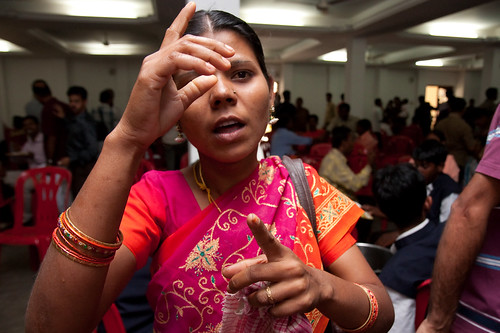
A young deaf woman talks passionately as lunch is served following the Kerala Sign Language Bible dedication event in Kochi, India. Over 1200 deaf people attended the event, a small representation of the estimated 9 million deaf people in India.
For more: Door International
Where the Disabled are not welcome
I would love it if you would spend a day looking at the various buildings that you enter and consider how easy they are to enter or exit. If there are no barriers to entrance, how wide is the walk way? Is it easy to negotiate without pulling things off of the racks or shelves? Are items set down low so that they are easy to reach? If someone is using a mobility devise, is the isle wide enough to go down with another person, or will the mobility device completely block the way? Is staff easily visible to help with items? Are the bathrooms completely accessible? Is the change room completely accessible?
The Kids are (kinda) alright: crack babies speak out [There’s a video that opens this piece – as I’m compiling these links, I can’t see it, so I can’t tell you what’s in it. Hence I have the note to edit this post before it goes live]
I enjoyed Vargas’ article, but I still have questions surrounding the role of race.
Crack was a drug with a heavy racial identification – while all types of people used it, the most prominent image of a crack user was a black person. Vargas’ article discusses how experts learned from the crack baby hysteria and have not rushed to proclaim dire circumstances for children that are turning up meth exposed. But is the lack of hype due to meth being a white identified drug? Also, the pictorial accompanying the article focuses on Anzelone, and his nuclear family. Was there a difference in recovery and allocation resources by race? If so, how did that impact the lives and fates of these kids?
Following Up On What Neil Gaiman Said
Part of why I am taking the time to lay it out is my second reason for this post. I think it important that we see how celebrity fandom can obscure the work that my original post (and all my work on this blog) is trying to do. That is, pushing everyone to think about HOW they think about American Indians, what they THINK they know about American Indians, and how all of that comes together in the words they write and speak aloud.
Why are iPad Factory Workers killing themselves?
A growing string of worker suicides and attempts has plagued a Chinese factory operated by Foxconn, the China-based tech company that produces, among other products, the new Apple iPad. In the past month, four employees at a single factory have attempted suicide, and 11 workers have killed themselves since 2007. And perhaps even more telling, all four of the most recent attempts have taken place at the factory. What is happening to these workers that is causing so many to turn to suicide?
Unfortunately, the programme finishes on the rather clichéd interpretation that the novels demonstrate how women who didn’t conform ended up being branded mad and locked up – essentially, madness as a form of female repression.
This is the classic feminist criticism of historical ideas about madness and despite there being some truth to it, it is only supportable by ignoring the other side of the coin – the traditional interplay between insanity and masculinity.
News Headlines:
Canada: Manitoba Police use taser on mental health patient
US: Civil Rights Division pushes for Internet Accessibility
Apple admits using Child Labour [in a plant where people have been disabled by chemicals]