Daily Archives: 22 April, 2010

Bullying – How Can We Stop It?

Here’s another horrific story of bullying, this coming out of Dickson, Oklahoma.

Austin Avery was born prematurely and suffered developmental issues as a result. Last week, when the school called [his mother] Sharlene,  she  knew something was seriously wrong. “We had a call from the school to come pick him up cause he was hallucinating. I just don’t understand why your child goes to school and comes home in a drunken stupor,” says Avery. So, she put him in the car and drove to the emergency room. That’s when doctors told her something she never imagined. “The doctor said that [Austin] was way over the legal limit [for alcohol]. Now, can you imagine a 14-year-old child and what kind of damage that can do to his brain?”

The investigation yielded a report from a fellow student, who reported that bullies had been putting Germ-X, an alcohol-based hand sanitizer, in Austin’s milk at lunchtime. This had been occurring regularly since January, without detection by the school or any adult in a position to discipline the bullies.

There are a couple things of note about this story. First is that it got virtually no coverage – I saw it only because I read several hip-hop gossip sites that picked the story up because the child is African-American. Other than those sites, I found absolutely no mention of it anywhere on the web other than the initial report from a local news outlet, quoted above. Intentionally poisoning a child with hand sanitizer seems like a pretty big deal to me – there could have been much more significant and detrimental side effects than alcohol intoxication, and even alcohol intoxication is dangerous enough when we’re talking about a 14 year old with developmental disabilities.

The second thing of note about this story is that Oklahoma already has an extremely robust anti-bullying law and state policy aimed at eliminating bullying. A watchdog anti-bulling group gives the Oklahoma law an A, indicating it is “near perfect” by their standards. Here is a description of their anti-bullying law:

Requires Safe School Committees to give special attention to bullying, incidents of unwanted physical or verbal aggression and sexual harassment and make recommendations. Encourages community involvement, one-on-one student/staff relationships, use of problem solving teams of counselors and/or school psychologists and requires the review of bullying prevention programs utilized by other states, agencies or school districts.  Requires each school district to have policies addressing the prevention of bullying and education about bullying behavior.

So – given that all those rules, policies, requirements, and education were insufficient to stop Austin from being regularly and consistently poisoned for almost four months – how can we realistically address and stop this kind of bullying from happening? How can we provide meaningful protection for children with disabilities? Is it possible to do so through laws and regulations, or will only a long term shift in ableist attitudes be effective?
Recommended Reading for April 22, 2010

Warning: Offsite links are not safe spaces. Articles and comments in the links may contain ableist, sexist, and other -ist language and ideas of varying intensity. Opinions expressed in the articles may not reflect the opinions held by the compiler of the post and links are provided as topics of interest and exploration only. I attempt to provide extra warnings for material like extreme violence/rape; however, your triggers/issues may vary, so please read with care.

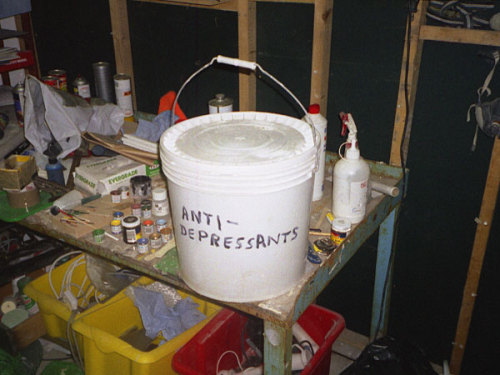
A very messy workbench sits in an equally cluttered room with an unfinished wall. Art supplies are scattered everywhere. In the center is a white plastic bucket which someone has used a marker to label "ANTI-DEPRESSANTS."

Photo by David Shrigley, via Learning Log.

Strict Deadlines, Disabled Veterans and Dismissed Cases

Three years ago, the [United States] Supreme Court said there are some filing deadlines so rigid that no excuse for missing them counts, even if the tardiness was caused by erroneous instructions from a federal judge. The court’s decision concerned a convicted murderer who had beaten a man to death. But now it is being applied to bar claims from disabled veterans who fumble filing procedures and miss deadlines in seeking help from the government. The upshot, according to a dissent in December from three judges on a federal appeals court in Washington, is “a Kafkaesque adjudicatory process in which those veterans who are most deserving of service-connected benefits will frequently be those least likely to obtain them.”

HODASSU: Help Orphans and Disabled Stand a Skill in Uganda

HODASSU vision is to develop a healthy and self-sustaining community that protects the rights of orphans, vulnerable peoples and persons with disability, through economic development, vocational training, education and counseling.

Disabled must figure in Sierra Leone rebuild

People with disabilities must not be left out as Sierra Leone rebuilds after ten years of civil war, say the writers of a new study on living conditions for the country’s disabled. Disability is a major issue in the west African country, where thousands of people had limbs cut off dightinguringthe1991 -2002 fighting which completely devastated the country, its infrastructure, its economy and people. Leonard Cheshire Disability’s report, just out, is one of the first comprehensive studies into disability in Sierra Leone. It is hoped the findings will help the needs of people with disabilities be included in rebuilding the country’s infrastructure and social services. “The disabled community’s voice is generally a voice that is not heard in discussions of development,” said Bentry Kalanga, the organisation’s senior programme manager for Africa. “Up to now disability has not been regarded as a major development issue; it must be highlighted more.”

Disability rights activists [in India] oppose copyright regime

The Indian Copyright Act does not explicitly allow for conversion and distribution of reading material in alternative formats that are accessible to persons with disability. A draft amendment, that was made public in February by the Union Ministry of Human Resource Development, introduces a copyright exception for reproduction or issue of copies in formats “specially designed” for persons with disabilities, such as Braille and sign language. However, this “token exception” leaves out a large section of people affected by cerebral palsy, dyslexia or partial impairment. A sizeable section of the visually impaired is not trained in Braille and relies on audio, and reading material with large fonts and electronic texts. The proposed copyright exception is of no use to this section.

New disability laws [in Scotland] are welcomed as spur to close pay gap and improve business practice

CAPABILITY Scotland has welcomed the introduction of the UK Equality Act, which it claims will help challenge discrimination against disabled people across the country. The disability organisation has offered its backing to the legislation, which will bring together all of the UK’s anti-discrimination rules under one banner and replace the existing Disability Discrimination Act. The act, which will come into force in October will compel companies to publish their pay scales for men and women and require public sector agencies to presume in favour of firms with good equality records when issuing public contracts.  But it also strengthens the duty placed on all service providers – including schools and other public sector organisations – to make reasonable adjustments to their facilities or the way they carry out their activities to enable disabled people to access their services.