Daily Archives: 8 April, 2010

Words, Language, Context

I had a conversation with Dorian the other day after he posted You Don’t Get It on his personal blog. He said:

My brain doesn’t really work like everyone else’s. So when you say you “know exactly what [I’m] going through”? You don’t, really. You know the same result – a paper not getting written. But you don’t really seem to explain the process that gets me to that point in my brain. It’s frankly kind of agonizing–I want to write that paper pretty badly! You don’t get it.

People didn’t like this comment of Dorian’s. [It also went ’round Tumblr for a bit.] One commenter said:

What exactly do you want people to say when you describe something like this? That you are the only one that goes through it? I can understand the hardship that you may be going through but that doesn’t mean someone else can’t experience too.

When I responded to this, I took the analogy away from struggling to complete tasks and to something that most people will see as a “real” disability [yay, disability hierarchy!!!!].

I do not have a chronic pain condition, nor do I get migraine headaches. When I’m in pain, my joints ache. I feel tired. My muscles are sore. I want to lie down.

I take some over-the-counter drugs, or have a bath, or nap, and usually wake up with little to no pain and go about my day.

When Don talks about his experiences, he talks about being in pain. His joints ache. He’s tired. His muscles are sore. He wants to lie down.

He takes a wide assortment of drugs: two doses a day of 12-hour morphine, a daily dose of oxycodin, the associated drugs to deal with the side-effects of both of those, and a few other things lying around for “breakthrough pain”, one of which we have to sign for before we take it out of the pharmacy, and another of which our regular pharmacy doesn’t carry routinely. He’s a full-time wheelchair user so he can leave the house more than once every few weeks. He spends most of the day lying down.

We use the same words to describe our pain.

Dorian also uses the same words to describe his difficulties in completing tasks that I do. When I’m procrastinating, I’m quite happy to tell anyone who will listen (and several who will not) that I’m procrastinating and having troubles and words won’t come and make my essay/blog spot write itself now please.

But my troubles are not the same as Dorian’s, anymore than my pain is the same as Don’s.

We just use the same words.

My point isn’t that people with disabilities need to use different words or that currently non-disabled people need to use different words. It’s that words come with context. When Don says he’s in pain, he’s typically talking about his chronic pain condition. When I say I’m in pain, I’m typically talking about having sat wrong for a few hours.

Context matters.
Recommended Reading for April 8, 2010

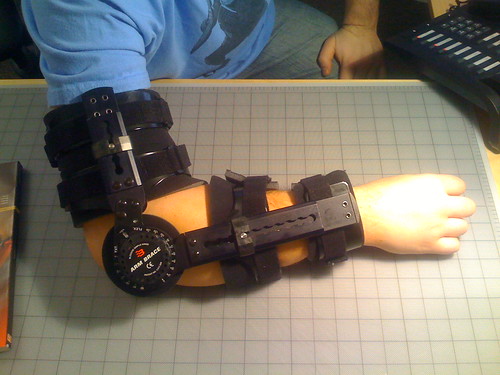
A white person's right arm in a (self-described) terminator-esque arm brace.  It has thick black straps supporting the upper arm, a huge dial on the elbow, and more thick straps on the lower arm

Description: A white person’s right arm in a (self-described) terminator-esque arm brace. It has thick black straps supporting the upper arm, a huge dial on the elbow, and more thick straps on the lower arm

Daily Access Irritations: The Moan Meme

I thought I’d rant a little about the access irritations I encountered today.

Today I’ll complain about inaccessible elements of the environment which nominally increase access. Otherwise known as “access theater,” or access done wrong, it’s particularly infuriating.

Implementation of Low Vision Rehabilitation Advice for People with Intellectual Disabilities

People with intellectual disabilities are at a very high risk of visual impairment, often due to undiagnosed refractive errors and cataracts. Oftentimes, however, these people are being cared for in facilities that do not have knowledge about low vision, and do not know how to detect it. Low vision centers in the Netherlands take a pretty proactive role in screening for visual impairments in people with intellectual disabilities. However, it doesn’t help much if the advice these centers give, for example for glasses or lighting, is not followed up on by the intellectual disability facilities the people live in.

Miscellaneous Thoughts on Parenthood [NBC series]

-Shockingly (or not), the behavioral therapist turns out to be a Magical Therapist who not only helps Max play with another child, but gives soothing advice to his mom–allaying her fears and improving her sex life. All in one afternoon!

It really bothers me to see people who work with autistic people portrayed as saints with no obvious flaws, which is what this therapist character (Gabby) seems to be so far. Because obviously anyone who would choose to work with autistic people must be a saint, by definition. Far too many people actually believe that kind of nonsense, which obscures the very real power which therapists hold over their clients, and the very real potential (and actuality) of abuse. It’s just really, really uncomfortable. Pretty Nice Behavioral Therapist Girl holds power over the children she works with.

Being inclusive vs not being exclusive

This is something I come across once in a while, and have had at least one argument with someone over. A group of people put on some creative project, and someone notices that there’s a lack of representation of X Minority for whatever reason, sometimes noting that they themselves are in the minority. The people organising the project get defensive and say “But we’re not excluding anyone! We are open to everybody! They just need to sign on!”

There is a huge difference between not being exclusive and being inclusive.

In the eye of the beholder

But we have entered into another phase of the understanding of beauty. We are staying, right now, in a huge resort north of Toronto. It’s on the way to the consultation and will cut our driving down by several hours. We decided, what the heck treat ourselves. Into a huge lobby, up to a luxurious room. Wow. Then Joe went into the bathroom and said, breathlessly like he has when listening to Madama Butterfly or contemplating a painting by Turner or finishing a book by Furst or by watching that nude scene in A Single Man … it’s, it’s, beautiful.

One Can’t be a Cutup when one is talking about Cutouts

The guidelines for my suggestions of “ideal cutouts” are simple:

1. All of the ADA style guidelines related to angle and such (not crucial for me with the iBot or most powered chairs, but much more important for scooters that can’t handle angles, manual chairs, or people that might have trouble with the angle);
2. Always have the ramp be at a complete 18090° with the street it is bisecting, with a consistent and equal upward trend until it reaches the top.
3. Keep the direction of the inclination be the same as the direction of travel, without requiring left/right “yaw” adjustment.
4. Have the cutouts as close to the curb as is feasible.
5. Position the cutouts firmly in the crosswalk’s span.
6. Keep the cutouts on opposite sides of the street that assume a lateral connection lined up with each other.
7. When fancy painting/grooves are done, have the paint/groves match both the angle and the direction of the inclination (i.e. if any of the previous two points — especially points 2 and 3 — are not done, do not use the paint/grids as if they were).
8. Remember that Functional > Aesthetically pleasing but impractical > impassible (by which I mean impossible).

Headlines:

US: Appellate court rules [service] dogs ineligible for food stamps

Just to let y’all know, we’re going to be splitting up Recommended Reading duties among FWD contribs for a while, starting tomorrow!

Quickhit: Kelly Vincent elected to Upper House in South Australia!

The results have been declared!

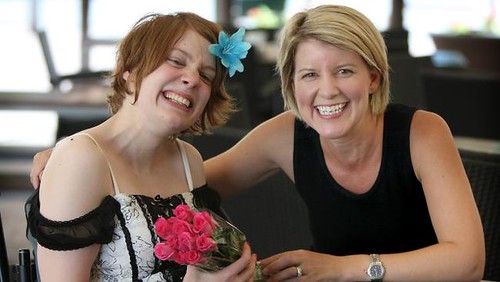
Kelly Vincent and Natasha Stott-Despoja

Image: A smiling Kelly Vincent, Dignity for Disability candidate, with a blue flower in her hair and holding a bouquet of pink roses, sits next to former leader of the Australian Democrats Natasha Stott-Despoja.

South Australia State Parliament gets first disabled politician*

Labor and Liberal won 4 seats each with the Greens and Family First each winning a seat.

The make-up of the new Legislative Council will now be Labor 7, Liberal 8, Greens 2, Family First 2, independents 2, and D4D 1.

Ms Vincent has made Australian parliamentary history by being the youngest elected Upper House MP in Australia’s histolry, the youngest female ever elected to an Australian parliament, and the first person who uses a wheelchair to be elected in the SA Parliament.

“South Australians have shouted their intentions loud and clear,” she said after the count.

“People with disabilities and those who love them will no longer be silenced. I will be a voice for those without a voice.”

Parliament House will now have a scramble to make the Chamber accessible – they’ve never bothered before.

* I strongly suspect she’s not the first disabled politician. Perhaps the first where anyone else has noticed.