Monthly Archives: March 2010

Bake Sales for Chemo

I recently read a story of a woman forced to have fundraisers to cover her chemo treatment after she was excluded from purchasing insurance coverage because of a separate pre-existing conditions:

Iowan grandmother Deb Robben  shopped the insurance market, looking for a company that would cover her. Unfortunately, after a lengthy search, she was unable to find a single insurer that was willing to offer her coverage; the companies denied her coverage because they considered the benign cysts in her breasts to be a pre-existing condition.

Last December, Robben was diagnosed with colon cancer. Because she has been unable to obtain insurance, she has had to pay the costs for treatment out-of-pocket. For chemotherapy treatment alone, Robben expects to pay almost $2,000 a month. “She’s only two months into chemo and already she’s at $50,000. Oh my, what is another four months going to bring,” says Melissa Gradischnig Nelson, a friend of Robben.

In desperation, Robben’s friends and family have turned to local fundraisers to try to pay for her treatment. Over the weekend, they held a $5-a-plate pasta dinner in the hope of putting “a dent” in Robben’s massive health care bills. Local news station WHO-TV recently interviewed Robben, who told them, “It’s kind of hard when you can’t get insurance. To say, lady you’re going to die or figure out how to come up with the money. It’s not right.”

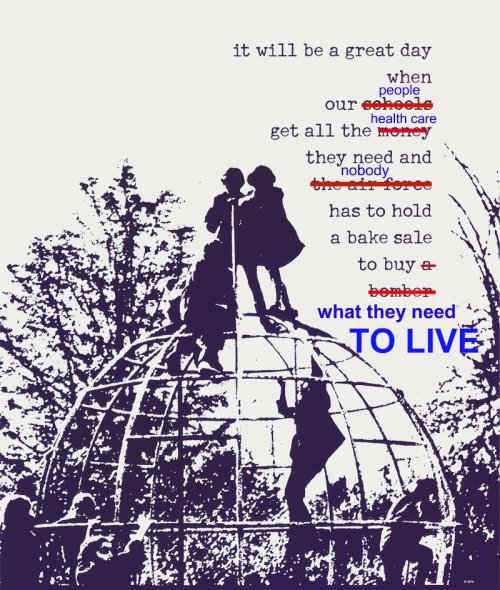
This reminded me of the bumper stickers I used to see with the slogan “It will be a great day when our schools get all the money they need and the air force has to have a bake sale to buy a bomber.” So I’ve modified it to reflect our modern times:

Graphic image of children on jungle gym with slogan about bake sales and bombers, modified to read "it will be a great day when people get all the health care they need and nobody has to hold a bake sale to get what they need to live."

Oh Canada: This week in Canada & Disability

It’s been an interesting week or so in Canada regarding issues around disability. “Interesting” here means hit and miss.

I could, for example, direct you to the coverage of the Paralymic Games, but that site appears to be inaccessible to screen readers. It’s very busy, and has a lot of flash on it. There’s an audio slide show – the first I’ve ever come across – but you need to download something in order to run the audio.

So, hit and miss there, I guess.

Of course, then we get this story: No sugar-coating for disability exhibit: Co-curator’s trip out west parallels struggle to overcome obstacles in Out from Under

For disability rights activist Catherine Frazee, the personal overlaps with the political even when she doesn’t intend it.

That happened with Frazee’s recent journey to Vancouver from Toronto for Out From Under, a unique exhibition on the social history of disability in Canada.

As one of its three curators, she felt it was important to be here for the exhibition’s opening during the Paralympic Winter Games.

Frazee, the director of Ryerson’s Institute for Disability Studies, can’t fly for medical reasons having to do with living with spinal muscular atrophy, a genetic neuromuscular disease characterized by the degeneration of the motor neurons. When she travels, she is accompanied by an attendant and Patricia Seeley, her life partner.

The only option for her was to take the train.

Frazee was willing to make sacrifices to travel out west, such as sleeping in her electric wheelchair. She can’t be separated from her wheelchair, which is uniquely customized to her body’s needs. At times, for example, she has to tilt it slightly back to help with her breathing.

When she contacted Via Rail, she was told that she and her wheelchair had to travel separately.

Of course she was. *headdesk*

The exhibit itself sounds amazing and I wish I could see it. But it’s telling to me that in my country, where politicians regularly tell me they really care about the needs of people with disabilities, it’s impossible for Catherine Frazee to travel to Vancouver. Ultimately, she and her partner traveled through the US, where the Americans with Disabilities Act, as poor as it may be, still required that there be train cars that Frazee be able to use.

Or another hit and a miss: Promoting rights of disabled new foreign policy focus: Cannon

Promoting the rights of disabled people around the world will become a key foreign policy focus for Canada, Foreign Affairs Minister Lawrence Cannon said at the United Nations Thursday.

Cannon made the declaration after delivering Canada’s ratification of the world body’s Convention on the Rights of Persons with Disabilities.

Awwww. Isn’t that awesome?

Meanwhile our Prime Minister held a TalkCanada event that was inaccessible to blind or partially sighted people.

Yesterday morning Prime Minister Stephen Harper performed a first, by being the first Canadian Prime Minister to have his remarks streamed live through YouTube. Before and after the PM’s speech, and up until Sunday at 1:00pm ET, Canadians can login to the Talk Canada YouTUbe page to submit and vote on questions, which the PM will answer in another live stream on Tuesday.

As a completely blind Canadian and an Information and Communications Technology Accessibility Consultant (I help make information systems work for persons with disabilities), I take exception to the PM using technologies such as YouTube and Google Moderator (used for the questions and voting). These technologies were poorly accessible to me, and to other blind and partially sighted Canadians, including Derek Wilson who wrote about the barriers he faced. This is not the way that things need to be, it would have been very possible, should the PM have cared, to make the Talk Canada event easily accessible to a much wider range of Canadians, including the blind and visually impaired.

[I also have no idea if the actual videos will be subtitled, Signed, or a transcript provided.]

Oh, and Canada continues to refuse immigrants when family members have disabilities. The only ‘hit’ there is that we’re talking about it, I guess, since it’s been going on forever.

I’m frustrated. Politicians, business owners, school officials, everyone tells me that they really care about the needs of people with disabilities. They often do grand gestures: Ooh, we’ll show highlights from the Paralympic Games! We’ll agree that yes, we’re going to support the needs and rights of people with disabilities in other countries! We’re going to put in a Student Accessibility Services Office (because all people with disabilities on campus are students) and that will solve all the problems!

What we won’t do, apparently, is ensure that people with disabilities in Canada can get from Nova Scotia to Vancouver with minimal fuss and drama, like the currently non-disabled can. We won’t discuss how inaccessible politicians are to people with disabilities. We will express disdain that the laws in Ontario now require universities to be accessible to students before students spend months or even years self-advocating. We will approve bursaries for students purchasing equipment that helps them write their essays and do their school work in February – 6 months into the Academic year.

Oh Canada. Please do better.

Recommended Reading

Warning: Offsite links are not safe spaces. Articles and comments in the links may contain ableist, sexist, and other -ist language and ideas of varying intensity. Opinions expressed in the articles may not reflect the opinions held by the compiler of the post. I attempt to provide extra warnings for material like extreme violence/rape; however, your triggers/issues may vary, so please read with care.

Nisha at bell bajao: Regulation of Disabled Women’s Sexuality

The pressure to ignore the bodily experiences for a collective voice to locate and challenge the barriers “out there” has made disability theorists and activists collude with “the idea that the ‘typical’ disabled person is a young man in a wheelchair who is fit, never ill, and whose only needs concern a physically accessible environment.”[14] This collusion has led to the sidelining of disabled women, non-visible impairments, intellectual impairments, elderly with chronic conditions[15], and disabiliy’s interaction with gender and other social, cultural oppressions[16]. Further, it has ended up contributing to the disappearance of the embodied experiences from most disability literature[17]. […]

The social norm of sexuality which is based on being “able-bodied” and the material situations of disabled women as “asexual objects” creates “rolelessness” – “social invisibility and this cancellation of femininity” prompts some disabled women to claim essential femininity which culture denies them[25]. This may give the impression that most disabled women have freedom from the standards set by the patriarchal male gaze and that they are in a position to develop and lead happy alternative lifestyles. In reality, imagining them as “antithesis of the normative woman”[26] adds to their disadvantage of being women.

Lisa I. Iezzoni and Laurence J. Ronan at the Annals of Internal Medicine: Disability Legacy of the Haitian Earthquake

Even before the earthquake struck, Haiti had few rehabilitation professionals and little capacity to manufacture essential assistive technologies, including prostheses and wheelchairs. While international organizations are assisting to fill these gaps, ultimately rehabilitation programs and assistive technologies will need to fit the specific demands of Haiti’s culture and rugged natural physical environments. As Haiti rebuilds its public and private spaces, ensuring accessibility to persons with disabilities will be critical.

About.com: Wheelchair-Using Child Actor Sought for NBC Pilot

If you’ve been unhappy with a character who uses a wheelchair being played by an actor who doesn’t on Glee, here’s some promising news: An open online casting call has gone out for a child actor who uses a wheelchair to play the son of Paul Reiser (pictured) in a pilot for NBC. The casting call, seeking performers age 10-13, describes the character as “sweet, funny, really smart and upbeat. He loves sports, music, and everyone he meets — especially adults. Inquisitive and with a mind like a steel trap, he remembers everything — which can be good or bad! He can easily get anxious and sometimes gets a bit obsessively focused on things. And oh, he has used a wheelchair since birth.” Not quite sure how you use a wheelchair at birth, but I applaud the intention.

NSW Human Services: Community garden for people with a disability

A community garden at Macleay Valley Community Care Centre is proving its value to people with a disability. Not only does the garden offer a place for them to enjoy or simply relax, it also provides them with fruit and vegetables.[…]

The project involved erecting a fence around the garden, screening under an existing deck, laying concrete paths and removing existing diseased trees. Six planting troughs were concreted into an area that is wheelchair accessible and garden beds are at a suitable height so they can be easily reached by older citizens and people with a disability.

World Health Organisation: Marking International Women’s Day [podcast transcript]

Veronica Riemer: Women are also facing discrimination in their opportunities for education. Bliss Temple from North Carolina in the USA, is a medical student who uses a wheelchair because of her disability. She talks to us about the challenges she has faced in taking forward her studies.

Bliss Temple: When I went to apply to medical school, because of my disability, I knew that it was unchartered territory. So I applied very widely to 28 different schools. About a third of them rejected me out of hand and said “you are too disabled; we won’t even consider your application”. It ended up that I did get accepted in several places and at the school that I chose, Duke University, I was the first person who was a wheelchair user. I think the first with what many people would classically think of as a disability; although there have been people with mental health problems.

Veronica Riemer: Bliss tells us why it is important for persons with disabilities to be accepted for medical training.

Bliss Temple: The world of medicine can really use people with disabilities. We are health care consumers of course and it is really important that we have more providers that understand the experience of having a disability.

The Wichita Eagle: Disability advocates ask court to halt cuts

A petition filed Friday by InterHab, an association for developmental disability service providers, seeks a temporary restraining order and asks that $10 million cut by the [Kansas] governor and Legislature be returned.

The cuts mean services for Topeka advocate Nancy Spano’s daughter Heather have been greatly scaled back. Heather is 24, but health problems and severe developmental disabilities mean she functions more like a 5- or 8-year-old child. Spano said her daughter needs round-the-clock care and help with basic hygiene. After the cuts, Heather was left alone at night and had no staff for help on the weekends. She frequently called her parents at all hours of the night, frightened.

Recommended Reading

Warning: Offsite links are not safe spaces. Articles and comments in the links may contain ableist, sexist, and other -ist language and ideas of varying intensity. Opinions expressed in the articles may not reflect the opinions held by the compiler of the post. I attempt to provide extra warnings for material like extreme violence/rape; however, your triggers/issues may vary, so please read with care.

Ally at Every Crooked Step Forward: Well, there goes that plan.

We, as members of the disabled community, do not need you to represent us, artistically or otherwise. We need to be given the opportunity to represent ourselves. We do not exist to provide you something interesting to look at, dissect, discuss, or parody. We do not exist to provide you with thinking points or talking points. We are not a theme. We are not the gun on the wall. We are not here to make a point to you about the preciousness of life, the resiliency of the human spirit, or even how fucking weird the world can be. Our lives are not made meaningful by enriching or educating you. We do not need you to make our lives meaningful.

newsflash in accessibility_fail: Mt. Holyoke College fails [more in comments at link, and at Dog in the Dorm]

To make a long, painful story very short, she’s had a shocking, nightmarish experience at Mount Holyoke, which you would expect to be a liberal, supportive environment since it’s a women’s college. She was led to believe everything would be in place for her arrival and that disability services there were top notch. However, it’s been a nightmare. She was unable to eat in the cafeteria the first two months of school because the student workers told her she couldn’t bring a dog in. Disability services told her they weren’t sure what they could do, because not all student workers might understand an email saying they couldn’t refuse her service. She was given a room on a third floor that her scooter wouldn’t fit in, and when she complained she was told to leave her expensive piece of medical equipment in the lobby. When they finally moved her to a new dorm room, she had to go across campus to shower in her old dorm because they didn’t install grab bars in her shower.

Stephen Kuusisto at Planet of the Blind: Disability and Its Discontents

Most of this blog’s readers are familiar with this puzzle, many of them are, like me, living that puzzle. Many of them are alertly, day by day building lives of evident accomplishments with or in spite of disabilities; many are still misunderstood when they’re on street. “How do you know when you dog has made a poopy?” asks a woman. And one wants to say, “Well I have an advanced degree Madame.” Mostly one winces. Moreover, one says something benign: “They teach you about that at the Guide Dog School”.

The Vancouver Sun: No sugar-coating for disability exhibit

For disability rights activist Catherine Frazee, the personal overlaps with the political even when she doesn’t intend it. That happened with Frazee’s recent journey to Vancouver from Toronto for Out From Under, a unique exhibition on the social history of disability in Canada.[…]

The only option for her was to take the train. Frazee was willing to make sacrifices to travel out west, such as sleeping in her electric wheelchair. She can’t be separated from her wheelchair, which is uniquely customized to her body’s needs. At times, for example, she has to tilt it slightly back to help with her breathing. When she contacted Via Rail, she was told that she and her wheelchair had to travel separately. […]

From Toronto, Frazee and Seeley drove south to Chicago where they got on a train that had a railcar with an accessible room. They travelled across the U.S. to Seattle, where they rented a van with a ramp and drove north to Vancouver. The irony of not being able to cross the country for a disability exhibition during the Winter Paralympic Games wasn’t lost on Frazee, one of the country’s most articulate advocates for the rights of the disabled.

tonic: Nonprofit Sends Heavy-Duty Wheelchairs to Haiti

Whirlwind Wheelchair International is sending 350 specially designed extra-durable wheelchairs to Haiti to help those who need them most.

Have you seen the movie Murderball? The Internet Movie Database calls it, “a film about paraplegics who play full-contact rugby in Mad Max-style wheelchairs.” While rugby and extreme sports have little to do with Haiti at the moment, wheelchairs sure do, especially “Mad Max-style” ones. In a situation where towns are covered in rubble and many people have severe injuries from the recent earthquakes, there’s a desperate need for low-cost, durable wheelchairs.

Oregon Live: Multiple sclerosis turns the tables on Portland oncologist, as patients become caregivers

Patients, who typically expect doctors to be invincible and need them to be on top of their game, had to know, too. Word spread swiftly.

One patient in the throes of treatment texted Webster, asking how she was. Webster remembers replying: “Don’t worry about me. I’ll be back.” The woman, adamant that sometimes — even in the stoic world of medicine — the tables turn, wrote, “No. We get to worry about you, too.” […]

She lived in a three-story townhouse, and just managing the stairs would be a hefty challenge. She’d need rides to doctor and therapy appointments, not to mention assistance with routine household tasks, especially during the hours when her partner, another busy physician, wasn’t around to help.

As patients offered to assist, Webster wrestled with the question: Was it OK to let them?

Tasting Fear

[This here is a warning that the author has written a post about, amongst other things, being depressed and suicidal. For this reason there is a clicky thing. Use it in whatever health you got. Also please note that with respect to my wife and our marriage you are getting exactly one perspective–mine–and everything is filtered through my experiences of abuse. This is not an objective reporting of events.]

Y’all who’ve been following this adventure know I’ve been fucked up for a while now. It’s been next to impossible to get any work done–it took me until five-thirty this morning to get caught up on my inbox. Today I got to explain why I should keep my job. On the phone. I don’t know as I was very convincing. Being highly ambivalent about wanting to keep it at all isn’t helpful with the convincing. Nor the panic that comes with phones, the stammering dysphasia aphasia that is so heavily influenced by stress.

Maybe I’ll get to keep it through the end of the month. I keep telling myself I should be at my desk now working.

I’m in bed with the notebook and I haven’t gotten dressed. I woke up six hours ago. Continue reading Tasting Fear

Photos from Mental Health Institutions in Indonesia

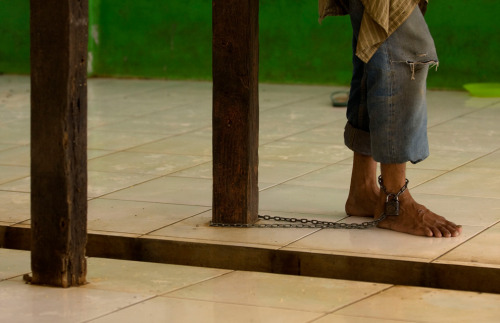
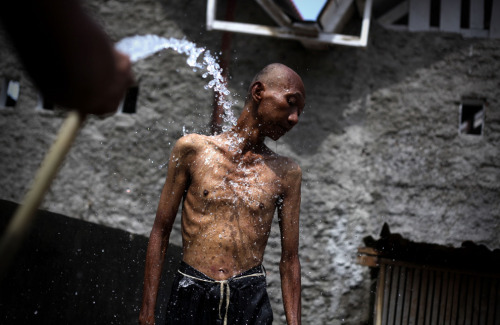
The Big Picture, one of my very favorite photo blogs, in which the Boston Globe collects a set of stunning photos on a single topic or theme, recently had a series on Indonesia. Two of the photos especially caught my eye, as they depicted scenes from mental health institutions in the country.

In a room with vivid green walls and white tiled floor, a person is seen from the knees down is chained to a wooden pole with a metal link chain. The person is barefoot, wearing dingy jeans with a tear in the knee.

The leg of a patient is chained to a post at the Galuh foundation for people with mental health conditions on February 10, 2010 in Bekasi, Indonesia. Belief in black magic is commonplace in Indonesia, where there is much ignorance over mental health issues, with traditional healers instead consulted for apparent sufferers. 2007 figures suggested that 4.6% of the nation suffered from serious mental disorders in a country whose population now stands at around 230 million, with only around 700 psychiatrists across 48 psychiatric hospitals available to help treat those affected. (Ulet Ifansasti/Getty Images) #

A shirtless boy, thin with protruding ribs, turns his head to the side as he is sprayed with a water hose. Behind him are walls of broken concrete.

A patient named Yoyo is bathed at the Galuh foundation for mental patients in East Bekasi near Jakarta on February 11, 2010 in Bekasi, Indonesia. With limited mental heatlth care available in Indonesia, sufferers usually turn to black magic and are taken to “dukuns” or healers who are believed to have magical powers. (Ulet Ifansasti/Getty Images) #

Chatterday! Open Thread.

This is our weekly Chatterday! open thread. Use this open thread to talk amongst yourselves: feel free to share a link, have a vent, or spread some joy.

What have you been reading or watching lately (remembering spoiler warnings)? What are you proud of this week? What’s made your teeth itch? What’s going on in your part of the world?

Today’s zombie-kitten Chatterday backdrop is via the Daily Squee.

Sunlit cute kittens walking on hindlegs like zombies

QuickPress: E-Library for Women with Disabilities in Africa

I received this via a mailing list I’m part of.

Check out http://www.nawwd.co.za for an e-Library developed to support Women with Disabilitiies in Africa

In September 2009 the Secretariat of the African Decade of Persons with Disabilities (SADPD) commissioned Disability Action Research Team (DART) and CBR Education & Training for Empowerment (CREATE) to strengthen the Network of African Women with Disabilities (NAWWD). The brief included development of this e-library.

Electronic resources were collated during a systematic review of information relating to women with disabilities in Africa. The website domain contains a collection of articles, research reports, factsheets, documents and training packs produced between 1994-2009. Searches were conducted on the websites of key international Non-Government Organisations (INGOs) and Disabled People’s Organisations (DPOs,) as well as several other international bodies such as the African Union (AU). The searches took place over a period of 3 weeks and were restricted to documents which are available at no cost; all of these are in English, but where Portuguese or French versions were available, these are included. Electronic copies of all the articles cited here are available in different formats (MS Word and PDF). In addition, there is a list of websites and organizations which may be useful resources to women with disabilities on the continent.

Recommended Reading

Since I couldn’t do a Rec Reading yesterday – my spoons were needed elsewhere – here’s a bumper edition for today.

Warning: Offsite links are not safe spaces. Articles and comments in the links may contain ableist, sexist, and other -ist language and ideas of varying intensity. Opinions expressed in the articles may not reflect the opinions held by the compiler of the post. I attempt to provide extra warnings for material like extreme violence/rape; however, your triggers/issues may vary, so please read with care.

Thedeviante at The Deviated Norm: Today In: Things Any Disability Rights Activist Could Tell You

So, people are nosy assholes. Well, let me amend that. Many people think that your body (or your loved one’s body) is totally their business, the second that you (or your loved one) have something that sets you apart from “normal.”

Things that set you apart from “normal” include: being pregnant, having a visible disability, having an invisible disability (and telling people about it), being mentally ill (and telling people about it), being fat, oh, and getting one of the “big” sicks (including our good friend cancer).

Let me tell you a little story.

Nicholas Patrick in The Age: Australias disability laws need critical review

For some four million Australians and their families, a threadbare patchwork of state and federal laws, often ignored international conventions and, an all round lack of understanding make life more challenging than it already is. What’s needed is a complete review of the existing legal framework to ensure that people with disability live lives of dignity and can realise their potential to fully participate in Australian society.

Much newsprint and digital space has been devoted to such issues as wheelchair access on domestic and international flights, mental health in the Northern Territory, and, on Four Corners recently, the dire state of government support for parents of children with disabilities. Other cases, gaining less media attention, such as access to education and electoral rights for voters, are progressing through the courts.

Yet, for all the very real pain and injustice these stories draw on, they are only mountain peaks of public awareness. The state of legal rights for people with disability are, in fact, far worse than even these very serious cases might suggest.

Sarah Burnside at Challenging The Market: Sarah Burnside on market logic and welfare reform

Opposition Leader Tony Abbott drew media attention recently for proposing a “welfare crackdown”, to include compulsory work-for-the-dole schemes and higher threshold for eligibility for disability pensions. With respect to the latter, Abbott proposed a review by the National Audit Office to determine more stringent eligibility rules for the disability pension and suggested that recipients with “less serious medical conditions” be required to undergo annual medical reassessments and sit two interviews each year to “encourage them into employment”. Currently, 700,000 Australians receive the disability pension. Abbott estimates that around one-third of these people have conditions he would class as “less serious”. […]

Second, Abbott’s classification of muscular-skeletal and psychological/psychiatric disabilities as the categories within which “less serious” conditions might be found seems opportunistic. Muscular-skeletal conditions may involve chronic pain which is inherently difficult for external parties to perceive. Similarly, psychological or psychiatric illness is not readily identifiable by bureaucrats seeking to limit entitlements to government benefits.

The nomination of these categories suggests a certain lack of sophistication – if someone’s not in a wheelchair or holding a cane, they must be capable of work.

CBC News: Canada ratifies UN treaty for disabled rights

Canada has ratified the UN Convention on the Rights of Persons with Disabilities on the eve of the Paralympic Games in Vancouver.[…]

However, the convention is about much more than adding wheelchair ramps. It shifts the focus from institutionalizing those with disabilities to housing them in the community and allowing disabled people to challenge in Canadian courts, laws or policies that contravene the international law.

However, the signing did not go ahead without a glitch. The location of the news conference had to be hastily changed when organizers realized the original room was not wheelchair accessible.

NPR: Google Launches Closed Captioning For YouTube [Transcript included]

Google this week introduced closed captioning for the deaf on its YouTube video site. Ken Harrenstien, the lead engineer behind Google’s automatic captioning technology, says that as a deaf person he lobbied his bosses for years to introduce the technology.

WorldNewsVine: Disabled Nigerians Demand Their Rights to Vote

People with disabilities are proposing the creation of the National Commission for Persons with Disabilities Bill in the National Assembly of Nigeria. The proposal has been submitted and under consideration with the Federal Government of Nigeria for almost 4 years, yet nothing has been done by the lawmakers so far.

Speaking on stigma and discrimination against women with disabilities, the National Financial Secretary of Persons with Disability, Miss Bilkisu Ado Zango said that as long as the males in Nigeria are concerned “disabled women are corpses and the living have nothing do with the dead”.

“Women with disabilities face tipple the challenges men with the same conditions experience in Nigeria with regard to education and employment. The society in Northern Nigeria believes that women in general do not need to be educated. Disabled women seeking recognition; therefore might seem an impossible task; however, we believe that we will be able to break through.”

Wired: DARPA Pushes for Fail-Proof Prosthetics

DARPA, the military’s risk-taking research agency, is launching the next phase of its Revolutionizing Prosthetics program, which was started in 2000 with the goal of creating a fully-functioning, neurally-controlled human limb within five years.

BBC: DVD offers crime prevention advice for deaf people

The DVD was devised by Kevin Childs from Gwent Police, who had spent time working with deaf people in the area. He teamed up with the British Deaf Association and made the film featuring two deaf lead characters in various crime prevention scenarios. The film will now be distributed to forces throughout the UK.

Insp Childs said after working with local community groups he had concluded the main challenges were a lack of suitably accessible crime prevention literature and lack of engagement with, and access to, police officers. The DVD offers a variety of visual aid options for users which can be switched on and off as needed, including signing, subtitles in a variety of languages and a facility for lip reading.

ruthtamari at Life Changes: Personal Leadership & Being the Difference

My dream and vision for Toronto, Canada is that the city will be accessible by anyone who uses a wheelchair, scooter, walker, crutches, cane or assistive device. Every curb, entrance, washroom, subway, bus, theatre, restaurant and building would be accessible by everyone. Wouldn’t that be an amazing city to live in? One thing that is sure to promote healthy living, healthy aging, healthy communities and inclusion is having access to whatever you want to do and wherever you choose to go.

SF State University News: Anita Silvers honored for lifetime achievement

Anita Silvers, professor and chair of the Philosophy Department and a nationally recognized advocate for disability rights, was awarded the 2010 Quinn Prize from the American Philosophical Association (APA). […] Disabled by polio as a child, Silvers is a leading advocate for equality for persons with disabilities. Her papers and books have contributed to the legal interpretation of the Americans with Disabilities Act, enacted in 1990. Her groundbreaking and acclaimed monograph, “Disability. Difference. Discrimination: Formal Justice” (1998) is widely cited in legal affairs. “Americans with Disabilities” (2000), which she co-edited with Leslie Pickering Francis, anthologizes essays by other leading philosophers, as well as legal theorists, bioethicists and policymakers on the moral foundations of disability law and policy.