Daily Archives: 8 March, 2010

International Women’s Day: Subverting the Narrative

The earth from space in a purple filter, with text: Blog for International Women's Day - Equal Rights, Equal Opportunity

I encourage you today to check out Gender Across Border’s Blog(swarm) for International Women’s Day. Throughout the day, the GAB editorial board (including Emily Heroy, Colleen Hodgetts, Jessica Mack, Carrie Polansky, Erin Rickard, Elizabeth Switaj and Tatiana McKinney) will be updating GAB to highlight particular posts. It’s never too late to participate!

There were two themes, and I, of course, took this one:

Describe a particular organization, person, or moment in history that helped to mobilize a meaningful change in equal rights for all.

I think it’s fairly clear that I admire Helen Keller, and resent the way what she did with her life has been reduced to parody, the subject of infantile jokes about people who are Deaf-Blind, and forgotten about. When people bother to tell bits of her story, about her learning words at a well after weeks of patient tutoring from Anne Sullivan, it becomes a form of Inspiration that’s based entirely on pity. Oh, how tragic her life could have been, shrouded in darkness and silence. And then she learned to speak! And all was well!

I’m going to interrupt this post to point you towards a previous one I wrote about Keller: Feminist Icons

[This part is actually quoted from the book Lies my Teacher Told Me.]

Keller’s commitment to socialism stemmed from her experience as a disabled person and from her sympathy for others with handicaps. She began by working to simplify the alphabet for the blind, but soon came to realize that to deal solely with blindness was to treat symptom, not cause. Through research she learned that blindness was not distributed randomly throughout the population but was concentrated in the lower class. Men who were poor might be blinded in industrial accidents or by inadequate medical care; poor women who became prostitutes faced the additional danger of syphilitic blindness. Thus Keller learned how the social class system controls people’s opportunities in life, sometimes determining even whether they can see. Keller’s research was not just book-learning: “I have visited sweatshops, factories, crowded slums. If I could not see it, I could smell it.”

I think Helen Keller changed the world, or at least did an awful lot of work towards changing it. But, even with focusing on her achievements, on her work, it’s important to put her in context.

Helen Keller was a white middle-class woman from the US. She was young and pretty and very talented. Before she became famous as The Deaf-Blind Girl (because, of course, there can only be one Deaf-Blind Girl, and she is always white), Laura Bridgman was The Deaf-Blind Girl. And Bridgman was not as pretty, not as nice, and not as accomplished as Keller.

I mention Laura Bridgman because, if the whole purpose of the Helen Keller Narrative was Nice Deaf-Blind Girl Does Good (and thus you, gentle reader, should put your life in proper perspective!), then Bridgman fits almost the same bill. She learned to read and write, wrote letters to her fans, was on public display with ribbons to hide her eyes, and was just as famous as Keller. So why is our dominant narrative Keller and not Bridgman?

Well, what better way to discount someone’s radical roots than to turn them into an Inspiring Story, and nothing more?

So, for International Women’s Day, I want to remind readers that there are certain stories that we tell about certain women, and that these stories have a purpose.

Perhaps we can subvert that.

Check out Gender Across Borders throughout the day for more posts. A list of participating blogs
Recommended Reading for Stardate 63649.1

Warning: Offsite links are not safe spaces. Articles and comments in the links may contain ableist, sexist, and other -ist language and ideas of varying intensity. Opinions expressed in the articles may not reflect the opinions held by the compiler of the post. I attempt to provide extra warnings for material like extreme violence/rape; however, your triggers/issues may vary, so please read with care.

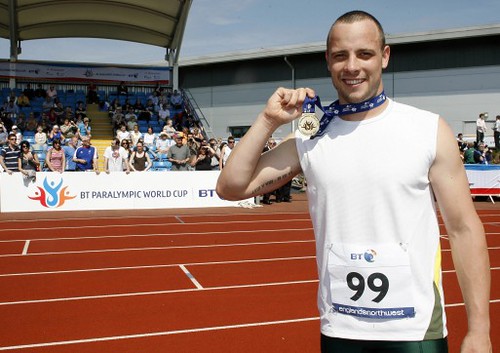
Oscar Pistorius shows off his medals on a sunny day at the track

More Than The Games: Pistorius hoping for fast times at the BT Paralympic World Cup

Oscar Pistorius will again be the marquee name of the 2010 BT Paralympic World Cup after the South African confirmed his participation at the annual event in May. The 23-year-old, a four-time Paralympic gold medallist, will defend his 100m and 400m titles in Manchester as he continues his bid to compete at the 2012 Olympics and Paralympics in London.

In 2008, Pistorius, dubbed the Blade Runner, was cleared to compete at in IAAF able-bodied events by Court of Arbitration for Sport, but failed to achieve the qualifying time for the 2008 Olympics by 0.7 seconds.

Laura Overstreet at LeftyByDefault.com: Things that make you go hhhmmm….

Getting a Maid of Honor dress has been a little more difficult, simply because I need separates and sizing is a little wacky with me. Not really a huge deal though. I decided that going to a dressmaker would be easiest. Or it seemed easiest until I visited one yesterday.[…]

She then said, “You are very unlucky,” and I don’t remember what I said or did, but I know I was in shock. That was a new one on me. I have been asked this question more times than I can count and never heard that one. She went on to say, “You must cry all the time.” Uh, not so much.

Wheelchair Dancer: Thinking Beyond The Label? Not Quite

The advertising campaign is the first nation-wide campaign about employment for PWD. It’s on the television and the radio; there’s a website. I have yet to see a paper version. It’s not working for me. It’s not just the slogan, “Evolve Your Workplace,” (eek — misuse! infelicities!), it’s the way disability is presented.

Activists have spent a long time trying to educate people about the dangers of assuming everyone is a “little bit disabled.”

Serene Vannoy at serenejournal: Next week: Disability Awareness Week!

Next week is Disability Awareness Week at Cal and we are working to spread the word as much as possible. […]

UC Berkeley is considered by many to be the birthplace of the disability rights movement, and the students, staff, and faculty of UCB are committed to continuing that tradition. That is why the Disabled Students Union, Disabled Students Program, and the ASUC are coordinating the fourth annual Disability Awareness Week.

UPI.com: U.N. to safeguard Haitian disabled rights

A group of U.N. experts will look into the plight of Haitians with disabilities, disproportionately affected by January’s earthquake, the United Nations said. […] The group also will look into the situation of people with disabilities in other countries affected by natural disasters, including Chile, which was struck by an 8.8-magnitude earthquake last weekend.

Sydney Morning Herald: All the world’s a stage – some can’t get in

But amid the graphs and tables illustrating the positive findings in the Australia Council for the Arts report More than Bums on Seats: Australian participation in the arts was some less palatable news: people with disabilities and migrants from non-English-speaking countries are being left behind.

The council’s last similar survey was released in 1999. How far has access to the arts progressed for people with disabilities – one in five nationwide, or more than 4 million? “Not very far would be my summary,” Australia’s Disability Discrimination Commissioner, Graeme Innes, says.

“Many, many venues are not accessible for people who use wheelchairs. There are only 15, I think, cinema screens around Australia – out of the 2000 or 3000 screens showing movies – that show movies with captions for people who are deaf or have a hearing impairment. There are even less cinemas providing audio description for people who are blind or have a vision impairment. I think that the arts community and deliverers of arts have got a long, long way to go before people with a disability are anywhere near in an equal situation.”

Sydney Morning Herald: Access still a hurdle, says film buff

Andrew Longhurst knows all about the difficulties that can discourage people with disabilities from going to shows or other forms of the arts and entertainment. As someone with a bone disorder who has used a wheelchair for most of his 35 years, he has encountered just about every barrier, beginning with physical access. “It’s a general rule that if you can’t get in the front door, it’s pretty much game over,” Longhurst says. But he’s not fussy: “Any door will do.”

Entry is just one consideration of many — from parking and distance to mobility challenges inside — when weighing up an unfamiliar venue. “I’m very adaptable . . . I can climb up steps on my backside,” he says. “I make it work. But if it’s entertainment, if it’s arts, it’s supposed to be enjoyable.”