Daily Archives: 18 February, 2010

Dear Imprudence: A “Tired Wife” Strikes Back?

The hits just keep on comin’, thanks to Slate. Earlier this month in Dear Prudence, we got to read this winner:

Dear Prudence:
My husband had a stroke 18 months ago. At first he was unable to speak and his right side was paralyzed. He regained his speech and, with a lot of work, got full use of his arm and leg. But the stroke made it impossible for him to practice his profession, and he continues to have short-term memory problems. He’s home on extended leave. My problem is that he is obsessed with what he has lost and how bad things are. When I come home from work—I have to keep us fed and housed—all I hear about is what a terrible state he’s in. I’ve tried various things: We’ve gone to a counselor, his doctor has given him anti-depressants, I’ve encouraged him to go back to his hobbies. I try to plan things that will be enjoyable for him. Nothing is working. He won’t take up his hobbies or socialize, and he dwells so completely on the negative that even his closest friends are getting weary. It seems to me that he should be grateful he survived and regained so much. I am so exhausted by his negativity that sometimes I just wish I could leave him, but I would never do that. Is this the way it’s going to be forever? –Tired Wife

First, something tangential: Is this not THE perfect mishmash of weird disability-related hangups from an abled person plus some lovely Feminine Mystique-era gender(ed) expectations? It’s like it was made for a takedown on this site.

Moving on: On one hand, I can certainly see why this woman is frustrated. Adjusting to newly-acquired disability can be an extremely difficult process — not only for the person with the disability, but for their relatives and loved ones as well. However, there are a ton of stereotypes made explicit in this woman’s letter, not least of which is the “he’s just so NEGATIVE!” and the related expectation that her actions and her efforts will somehow make him become a happy, compliant Good Cripple. I have to wonder, has she stopped to consider that adjustment to disability is a long process? Or that having to go on leave from one’s job due to a newly acquired disability might, in fact, be extremely taxing on one’s self-image? Apparently not — all that matters is that he show proper gratitude (and non-“negativity”!) for all of her efforts, and not trouble her with his “dwell[ing] completely on the negative.” I am sure that many of us would find it hard to be “grateful,” too, if we had someone treating us this way due to our disability (or disabilities). Once again, a disabled person’s feelings and experiences are steamrolled over in favor of those of a person who is not disabled, and this is apparently acceptable because they are in a relationship.

The gender question, too, is worth a look; while it’s pretty common knowledge that women, on average, do much more “caretaking” work inside the home than men (at least in the U.S.), there are a few things that stick out, mostly based on what the letter writer does not mention. Was she primarily responsible for managing her husband’s schedule and social life before his stroke? If “nothing is working,” has she spoken with him about it? Please understand that I am not trying to blame her for larger sexist patterns of who tends to do the home-related care-taking and who does not; it does, however, seem odd that she has not (as far as we know) attempted to speak with her husband about this — his “negativity” nonwithstanding.

The sense that I get from this letter, overall, is that this woman has spent a huge amount of time and energy trying to fulfill the role of the “perfect” wife, and now that her husband cannot fulfill the complimentary “perfect husband”/breadwinner role, her resentment is close to bubbling over. Add to this much of mainstream white, abled feminism’s emphasis on “independence” — which seems to exist in a magical land where no one is (or should be) dependent on anyone else — it is not terribly surprising that she feels that her only option would be to leave her “negative,” disabled partner. That these seemingly opposing tendencies could show up in one letter is not surprising, either.

So, what do you think, commenters?

Quickhit: “From Cool to Crippled” in advertising

Bad Cripple shows us a couple of ads, in Why Equality is Elusive, Part I and Part II.

DontDriveStupid ad

Description [emphases are mine]: The ad is headed, in red,

“Drive stupid and score some kickin’ new wheels.”

This heading is placed beside the image of an slim adolescent boy, white-appearing and dark-haired, wearinga red T-shirt, black jeans, and black Converse-style sneakers. He is sitting in a hospital-style wheelchair. His arms are slumped on the armrests, his back hunched, and his head bent such that his face is in shadow and not clearly visible.

The small text in the ad reads:

“Nothing’s cooler than the day you get your driver’s license. But as soon as you start driving stupid, it’s not so cool anymore. Texting, using your iPod, racing, they all fall under the category of stupid. And dangerous. So before you get behind the wheel and try to prove how cool you are, here’s a little harsh reality. Nothing kills more Utah teens than auto crashes. Not fazed? Okay, how does the thought of spending the rest of your life in a wheelchair grab you? Look, every year far too many Utah teens go from cool to crippled in the blink of an eye. So if you’re one of those drivers who think they have something to prove, you can start shopping for your wheelchair now. And hey, if you think that’s harsh, wait until the day you roll it into school.

Drowsy Driving | Distracted Driving | Aggressive Driving | Impaired Driving | Not Buckling Up
Zero Fatalities
DontDriveStupid.com

As Bad Cripple says:

But the ad relies on antiquated and deeply rooted fears to scare teens noting that “every year far too many Utah teens go from cool to crippled in the blink of the eye”. Great, this undermines forty years of legislative initiatives meant to empower people with a disability. Teens are being taught that a wheelchair is akin to a tragedy, a fate worse than death.

If you go to the website, the header currently has a headshot of a conventionally-pretty white brunette girl with sutured wounds on her cheek and lip. The heading says, “Driving stupid can really make you look bad.”

So there’s the Don’t Drive Stupid campaign: it is assumed that for teen boys using a wheelchair is worse than death – and for teen girls, the worst possible fate is to have minor wounds on her face.

It is interesting to contrast these official messages – ableist, sexist, objectifying, dehumanising – with the posters made by high school students themselves for the campaign: a car knocking the motif off a signpost, ‘When you drive you hold someone’s life in your hands”, “you know you’re tired when you swerve to miss your car freshener“, “Last message received” with a crash and a breaking cellphone, and various others – none of which rely on stereotypes about marginalised groups at all.

~~~~

Next up, Bad Cripple brings us this Nike advertisement:

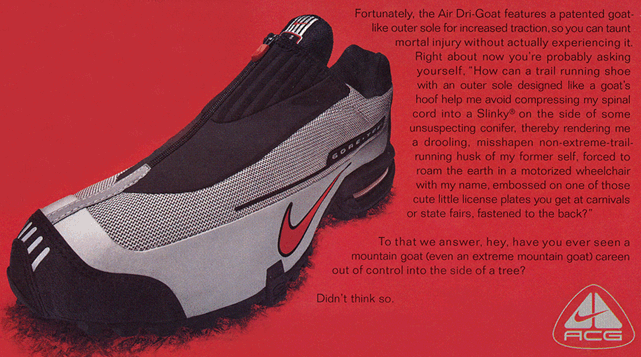
Air Dri Goat ad

Description: A Nike shoe sits on a red background. The text reads:

Fortunately, the Air Dri-Goat features a patented goat-like outer sole for increased traction, so you can taunt mortal injury without actually experiencing it. Right about now you’re probably asking yourself, “How can a trail running shoe with an outer sole designed like a goat’s hoof help me avoid compressing my spinal cord into a Slinky on the side of some unsuspecting conifer, thereby rendering me a drooling, misshapen, non-extreme-trail-running husk of my former self, forced to roam the earth in a motorized wheelchair with my name embossed on one of those cute little license plates you get at carnivals or state fairs, fastened to the back?”

To that we answer, hey, have you ever seen a mountain goat (even an extreme mountain goat) careen out of control into the side of a tree?

Didn’t think so.

Bad Cripple commentary reads, in part (check out the rest):

If anything is unusual about the above Nike ad it is the fact it was pulled. Imagery of this sort is sadly the norm and abounds. I see it every day on television, in newspapers, on the internet and in a plethora of magazines. Some people in disability studies call such images examples of the “defective person industry”.

Yup.

We are not to be believed

This post is going to talk in non-explicit ways about the sexual abuse of children with disabilities, and the inclination of people to not believe them.

Writing about the history of people with disabilities is often a process of reading between the lines. Surviving records tend to be written by non-disabled people in positions of power, with the only surviving writing from actual disabled people being those approved of by others.

My specific historic interest is in residential schools for people with disabilities in the Atlantic region of Canada in nineteenth century. I spent a lot of time last year trying to read between the lines, to sort out what really happened in the Nova Scotia School for the Deaf and Dumb when the second principal of the school was suddenly unceremoniously fired two years into his contract, with many records from his tenure there destroyed.

This may seem like an odd thing to bring up right now. Whatever scandal caused the school to fire him – and I argued in my thesis that it was because of his support for a specific method of teaching that was not approved of by the Board of Directors – it shouldn’t matter now. Everyone involved is dead, and the records can’t tell me much when they’ve been cut out of the record book with a razor at some indeterminate point in the past.

We’re trained to look for supporting documents, and I found my way to the New Brunswick Hansard (the recording of speeches in the Legislative Assembly) where Mr Woodbridge is mentioned quite extensively after a law suit was brought against him. I have yet to find the true nature of the allegations, since the men standing up to defend him considered the allegations so spurious, so scandalous, so without merit that they would not even name them, saying only that the girl who had brought the charges – she also was not named – had disappeared, thus proving that the charges were spurious.

For those of us who read narratives of childhood abuse in residential schools, this is a very familiar way of “dealing” with the problem.

I was thinking of this story when many people emailed me the following news report: Ex-students claim abuse at N.S. schools for deaf.

“The children were easily victimized because they were cut off from their families and also really cut off in a sense because of language, so they were perfect victims for sexual wrongdoing,” said Tony Merchant, the Saskatchewan-based lawyer handling the suit.

The comments, as all comments are on any discussion of charges of sexual abuse, are full of disbelieve and distrust.

I think of this, and I think of the distressing results of the only study in Canada that attempted to discover the abuse of people with disabilities in any form of institutionalised “care”. This PDF outlines their results on Page 3. To sum it up: Most people with disabilities, especially women, will be sexually abused in their lifetimes.

And we are not believed.

I look at the destroyed records in Halifax, and at the brief mentions I can find of accusations against Mr Woodbridge in 1886, and the accusations that former students are bringing against the school from the 1950s and 60s, and I wonder, truly, how many more people are not stepping forward because they know they won’t be believed.

ETA: People are discussing very specific and graphic examples of abuse of people with disabilities in the comments.

Recommended Reading for February 18th

Warning: Offsite links are not safe spaces. Articles and comments in the links may contain ableist, sexist, and other -ist language and ideas of varying intensity. Opinions expressed in the articles may not reflect the opinions held by the compiler of the post. I attempt to provide extra warnings for material like extreme violence/rape; however, your triggers/issues may vary, so please read with care.

Salon: How childbirth caused my PTSD [WARNING: story of obstetric assault and PTSD symptoms. More accurately labelled “obstetric trauma”, not “birth trauma”.]

He confirmed that I didn’t have PPD or any of its cousins. Yes, I had depression. Yes, I had anxiety. Yes, I was postpartum (four months at this point). But what I had was something else, something those specialists, so married to their own territory, couldn’t see. I had post-traumatic stress disorder.

Dis/Embody: Lost and masculine mobility [SPOILERS for Lost]

Perhaps the most frustrating thing about men and mobility impairments, particularly in dramatic television, is how often they are seen struggling against disability and attempting to overcome it to regain a properly dominant masculine identity. Disability as narrative obstacle, as it were. How much more novel and relevant would it be to watch a character adapt, craft alternative forms of masculinity, and resist cultural narratives of cure and exceptionalism?

Phoenix New Times: Shocking Pink: Arpaio’s Detention Officers Unnecessarily Terrorized a Psychotic Inmate Because He Resisted Wearing Pink Underwear [WARNING: assault, violence]

Esquire: Roger Ebert: The Essential Man

Now his hands do the talking. They are delicate, long-fingered, wrapped in skin as thin and translucent as silk. He wears his wedding ring on the middle finger of his left hand; he’s lost so much weight since he and Chaz were married in 1992 that it won’t stay where it belongs, especially now that his hands are so busy. There is almost always a pen in one and a spiral notebook or a pad of Post-it notes in the other — unless he’s at home, in which case his fingers are feverishly banging the keys of his MacBook Pro. […]

He calls up a journal entry to elaborate, because it’s more efficient and time is precious:

When I am writing my problems become invisible and I am the same person I always was. All is well. I am as I should be.

He is a wonderful writer, and today he is producing the best work of his life.

New York Times: Fighting Denied Claims Requires Perseverance

Ms. Carr’s form of shock is all too common. The Department of Labor estimates that each year about 1.4 billion claims are filed with the employer-based health plans the department oversees. Of those, according to data collected from health insurance industry sources, 100 million are initially denied. In simpler numbers, that is one of every 14 claims. […]

“About 53 percent of appeals work in our state,” said the Kansas insurance commissioner, Sandy Praeger. “That demonstrates that the process works.”

Chris Walters at The Consumerist: Protect Yourself From Unexpected Fees At Medical Clinics

An anonymous reader wrote to us to ask what he should do about unexpected bills from a medical clinic. He chose the clinic precisely because he can’t afford hospital bills in the hundreds of dollars, and was led to believe that there’d be no out-of-pocket cost. It turns out there was.

Jody McIntyre at Electronic Intifada: Interview: Disabled activist continues struggle in Bilin

Everyday, people were just waiting for the moment I would die. At first, on the news they said I was a martyr; my father heard on the radio that his son had died. Later, they changed the report, and said that I was a “living martyr.”