Daily Archives: 17 February, 2010

How Stigma Undermines Good Policies

There is sometimes significant pushback to talking about negative attitudes towards disabilities and PWDs. Those discussion are sometimes criticized for being too abstract, too removed from any practical effects on actual people. Sometimes people suggest that we focus instead on concrete policies and procedures that protect the rights of PWDs, so that tricky decisions aren’t left up to people who may act based on stigma.

As a policy wonk, though, I know that the best policy is only as good as its implementation. And if policy implementation and enforcement is in the hands of people with negative or uninformed attitudes towards PWDs, even amazing, sensitive, and nuanced policies will still lead to awful and horrific results.

For an easy example, imagine a company with a policy that required that  all newly hired employees be informed about their right to workplace accommodations for mental or physical disabilities.  The company works with disability rights groups to create a pamphlet outlining who is eligible for accommodations, what potential accommodations may be available, and the procedure for requesting accommodations and documenting a need for them. The disability rights groups make sure all the information is correct, that the pamphlet is available in alternative formats so it’s accessible, and that it emphasizes that accommodations are an employee’s right, rather than a bonus provided by the company. It is, in short, the perfect pamphlet.

Now imagine how much depends on the person who hands that pamphlet to the new employee. Take one scenario: the employee goes through a complete orientation and then is asked to wait in the lobby. When the employee asks why, the receptionist sighs “oh, it’s some stupid thing required by company policy. Just wait.” After 15 minutes, the designated human resources staffer comes out and thrusts the pamphlet at the employee, saying “Here, take this. It’s something I have to give you for policy. You have to sign here to show that I gave it to you.” When the employee asks what the pamphlet is about, the staffer replies “Oh something we have to do for disability, or whatever. Nobody is ever stupid enough to ask for any of these things, believe me.”

Compare that situation to one in which the employee sits with a single staffer to review all the new employee paperwork. At the end, the staffer says “There’s one more policy to review, and this one is especially important to our company. We place a high priority on accommodating employees with disabilities. Even if you don’t identify as someone with a disability, I want to review this with you so you can see how we ensure that employees with disabilities are equal players in our team. You might notice some employees with special equipment or who seem to have different schedules or other differences. This explains why we’ve provided these accommodations and why they’re not ‘special,’ but are important requirements for us to make sure that we accommodate and retain employees with disabilities.”

Exact same policy. Drastically different implementation that will certainly lead to drastically different effects on the individual employee in terms of willingness to identify as a PWD, request necessary accommodations, and their expectation of how the company will work with them on accommodation issues. I’d imagine that an employee in the first scenario might not ever request an accommodation for fear of being seen as a trouble-maker or someone trying to get “special rights,” or might have to go to a government agency or private attorney to actually enforce accommodation rights.

And those are the problems that can arise when attitudes and stigma complicate implementation of the actual policy as written – in both those examples, the new employee was actually given the pamphlet as part of the hiring process. What’s more troubling is when attitudes and assumptions lead to the policy not being implemented at all. There was a recent example of this with the United States Transportation Security Administration (TSA). As has been discussed extensively on this site and elsewhere, security theatre has resulted in implementation of all kinds of intrusive and extensive checks and searches of people flying commercial airlines. This is what happened last year in Philadelphia:

Ryan was taking his first flight, to Walt Disney World, for his fourth birthday. The boy is developmentally delayed, one of the effects of being born 16 weeks prematurely. His ankles are malformed and his legs have low muscle tone. In March he was just starting to walk.

Mid-morning on March 19, his parents wheeled his stroller to the TSA security point, a couple of hours before their Southwest Airlines flight was to depart. The boy’s father broke down the stroller and put it on the conveyor belt as [his mother] walked Ryan through the metal detector.

The alarm went off. The screener told them to take off the boy’s braces. The [parents] were dumbfounded. “I told them he can’t walk without them on his own,” [his father] said. “He said, ‘He’ll need to take them off.’ ” Ryan’s mother offered to walk him through the detector after they removed the braces, which are custom-made of metal and hardened plastic. No, the screener replied. The boy had to walk on his own.

The TSA policy is extremely clear about how to screen PWDs who use mobility aids such as braces:

  • Security Officers will need to see and touch your prosthetic device, cast or support brace as part of the screening process.
  • Security Officers will not ask nor require you to remove your prosthetic device, cast, or support brace.
  • During the screening process, please do not remove or offer to remove your prosthetic device.
  • The Security Officer will describe the explosive trace sampling procedure in advance to help you along with the process.
  • The explosive trace sampling process may require you to lift or raise some of your clothing in order to obtain the explosive trace sample. (Sampling areas can be accessed by you lifting your pant leg or shirtsleeve or by raising your skirt to knee-level.)

In this case, the attitude of the individual employees staffing the TSA checkpoint in the airport clearly trumped the policy. The parents of the PWD had no choice to comply or not be allowed onto their plane. When they complained to the TSA supervisor on site, they were told to “calm down and enjoy [their] vacation.” There are a lot of negative attitudes and assumptions being displayed here: PWD are probably faking and don’t really need their mobility aids; the dignity of PWDs isn’t important and can be overridden for “security concerns,” and enforcing the rights of PWDs is just making an unreasonable fuss.

That’s why it’s important to fight against stigma. Because it matters.
“Saying conjoined twins are disabled is insulting!”: Evelyn Evelyn, redux

[Cross-posted to Hoyden About Town]

Something that has really struck me about the conversations around Evelyn Evelyn is the reaction that “Conjoined twins don’t have a disability! To say they do is insulting!”

Not all commenters make the link between the two statements – some stop at the first – so I’ll take these two separately.

A little background: Evelyn Evelyn is Amanda Palmer and Jason Webley’s new ‘art project’, presented as fact but understood as fiction, in which they “discover” poor struggling musically-gifted conjoined twin orphan women, save them from their child porn and circus-exploitation past, and help them – in a long drawn-out process, due to the women’s traumatic fallout and difficulty relating – produce their first record. Palmer and Webley dress up as the twins to perform on stage, co-operating to play accordion, ukelele, and sing. They can barely restrain their sniggers while they interview about this oh-so-hilarious and edgy topic. More in the Further Reading.

“Conjoined twins don’t have a disability!”

So, a note on normalcy. The idea that some people would shout in defence “But conjoined twins don’t have a disability!” took me by surprise. I wonder how these people are defining “disability” in their heads, if they’ve ever thought about the subject – do they picture a hunched figure, withdrawn, unable to work, self-care or socialise? Do they picture someone undergoing huge medical procedures, someone with prostheses or other visible aids? What is the image in their heads?

Because disability can be all of these things, and none of these things. Disability isn’t a checklist, or a fixed point. Disability – and normalcy – are socially constructed. Disability is the interaction between a characteristic or a group of characteristics often called “impairments”, and a world that recognises people with these characteristics as abnormal.

Disability is considered a tragedy, a fate to be avoided at all costs. Disabled people are those that society defines as “abnormal”. Disabled bodies are the ones that don’t fit in typical boxes. Disabled people are people that the physical and social environment doesn’t accommodate. Disabled people are considered defective, deformed, faulty, frightening, feeble, freakish, dangerous, fascinating. Disabled people are stigmatised, laughed at, looked down upon, marginalised, Othered. Disabled people are medicalised. Disabled people are defined in terms of how currently-nondisabled people view them.

Disabled bodies are those that are subject to the able-bodied stare.

It is obvious with the most cursory of glances that in our society, conjoined twins are disabled. Society does not accommodate them. They are medicalised from fetushood. They are spectacle. Their operations are videoed and broadcast across the world. They are displayed, tested, stared at, discussed, and mocked, purely because of the shape and layout of their bodies. They are the subject of comedy fiction and “inspiring” tragedy nonfiction.

How can people simultaneously look at this project as funny and edgy and worth paying money to stare at, while considering conjoined twins to be “not disabled”? Why are their bodies so hilarious, then? Why is it so funny when Palmer and Webley cripdrag-up in that modified dress? Why do they snigger and smirk as they talk about “the twins” and their tragic tale? They do this – you do this – because you do see these bodies as Other. Fascinating, bizarre, freakish. Fodder.

People with disabilities resist these definitions, resist being marginalised, Othered, stared at, compulsorily medicalised. (Just as we try to resist, where possible, being beaten, abused, raped, exploited, exhibited, forcibly sterilised.) We laugh at ourselves plenty. We reclaim terms like “crip” and “gimp” and “crazy”. This does not grant able-bodied people free rein to mock us, to play schoolyard imitative games, to use child porn survivors as a little bit of “colour” for their projects.

There is a lot more to be said on the social construction of normalcy. I strongly recommend Lennard Davis’ Enforcing Normalcy . For more reading, check out this booklist at Hoyden About Town, our booklist here at Disabled Feminists, and our blogroll.

“To say that conjoined twins have a disability is insulting!”

This one’s quicker and easier to debunk. No, it’s not insulting. It’s as simple as that. It’s not an insult because being disabled is not an inferior state. Saying that someone is disabled is no more insulting than saying “Lauredhel’s a woman” or “Barack Obama is black”.

Being disabled just is.

~~~

Further reading on the Evelyn Evelyn conversation:

Annaham’s post here at FWD, Evelyn Evelyn: Ableism Ableism?

Amanda Palmer’s blog: The Whole Story Behind “Evelyn Evelyn” [WARNING: invented story about child sexual abuse and exploitation; the other links discuss this also]

Amanda Palmer’s blog: Evelyn Evelyn Drama Drama

Jason Webley: Blog #1 – Evelyn

Amanda Palmer’s twitter, in which she remarks “setting aside 846 emails and removing the disabled feminists from her mental periphery, @amandapalmer sat down to plan her next record.”, and follows up “pain is inevitable. suffering is optional.”

SPIN magazine: Meet Amanda Palmer Proteges Evelyn Evelyn

Sady at Tiger Beatdown: AMANDA PALMER WANTS TO SHOCK YOU. Just Don’t Get Upset About It, ‘Kay?

TVTropes: Rape Is The New Dead Parents

The linkspam roundups: First, Second, Third (and possibly more as time goes on)

Recommended Reading for February 17th

Warning: Offsite links are not safe spaces. Articles and comments in the links may contain ableist, sexist, and other -ist language and ideas of varying intensity. Opinions expressed in the articles may not reflect the opinions held by the compiler of the post. I attempt to provide extra warnings for material like extreme violence/rape; however, your triggers/issues may vary, so please read with care.

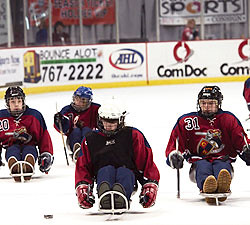
four people in uniforms and helmets on hockey sleds

new jersey newsroom: Sled Warriors: Children with disabilities teach disabled veterans how to play hockey

Here’s a twist. Imagine a child teaching an adult? Well, it’s being done right here in the Albany area where the kids’ Sled Warriors ice hockey team is holding a teaching clinic for adults.

The twist, you see, is this: the adults are disabled war veterans. Their teachers are youngsters who are athletic, strong-willed, courageous and determined – and physically challenged. It’s all part of the Stride Adaptive Sports program, a fairly new therapeutic recreation-related service for individuals with disabilities that spans many Northeastern states, including New Jersey.

hkfreeman at The Living Artist: Ableist Activism

It is a great irony that as I have become more aware of and invested in the need for social justice activism, I am less able than ever to participate in it. […]

In short, I am irked that right when I am most willing to Do Something, I am drowned in ableist pleas to Do Something that I cannot do. I am doing what I can – my art, blogging, participating in discussions when and where my spoons permit – but in the face of those endless pleas for phone calls, personal appearances, and donations, my best attempts are framed as pathetic excuses for avoiding “real” activism.

Times of Malta: Gozo churches urged to provide easier access for persons with disabilities

The National Commission, Persons with Disability, said today that complaints about lack of accessibility increased by 76 per cent last year compared to previous years. […] Mr Camilleri attributed the increase in complaints to the fact that people with disability were becoming more aware of their rights.

An area of concern, he said, was that despite the commission vetting building development plans submitted to Mepa, several new buildings still did not provide for access for persons with disability, meaning that the buildings were not built according to the approved plans.

BoingBoing: TSA forces travelling policeman to remove his disabled four-year-old son’s leg-braces

Philadelphia TSA screeners forced the developmentally delayed, four-year-old son of a Camden, PA police officer to remove his leg-braces and wobble through a checkpoint, despite the fact that their procedure calls for such a case to be handled through a swabbing in a private room. When the police officer complained, the supervising TSA screener turned around and walked away. […]

The screener told them to take off the boy’s braces.

The Thomases were dumbfounded. “I told them he can’t walk without them on his own,” Bob Thomas said. “He said, ‘He’ll need to take them off.’ ”

Ryan’s mother offered to walk him through the detector after they removed the braces, which are custom-made of metal and hardened plastic. No, the screener replied. The boy had to walk on his own.

Media Access Australia: Promoting captions at a young age benefits Deaf and hearing impaired students

Introducing captions at an early age has benefits beyond the individual child, as it impacts on changing attitudes and practice for all concerned. […]

The article looks at how using captions in a family setting from a young age promotes positive attitudes towards captions. Ensuring that all content viewed in the family home and at school is captioned helps normalise a child’s experience. Griswold also encourages the hearing impaired child to take ownership and become the ‘technology expert’ for switching captions on.

The Guardian: Anti-terror body scanners may be illegal, ministers warned

Ministers should act immediately to ensure that the use of full-body scanners at British airports is lawful, the ­Equalities and Human Rights Commission has warned.

The commission’s head, Trevor Phillips, told the transport secretary, Lord Adonis, ­serious concerns existed about invasion of privacy and there was an apparent lack of safeguards to ensure scanners were operated fairly and without discrimination.

L.A.Times: What makes Sammy run wild [meloukhia’s comment: “…the article gets better. Oh my stars, does it.”]

Obsessed with success, they find themselves in frenzies when the industry’s harsh reality clashes with their desires. Now, their condition has a name: Hollywood NOS. […]

Dr. Todd Zorick, a psychiatrist and professor at UCLA’s Semel Institute, calls the condition “Hollywood Not Otherwise Specified,” or Hollywood NOS. The unofficial term is a wry reference to the “NOS” designation in the Diagnostic and Statistical Manual of Mental Disorders, the bible of psychiatric ailments, which refers to a condition that impairs a patient but doesn’t fit with any specified, recognized disorder. Hollywood NOS describes a negative pattern of behavior for the sole purpose of achieving validation. The patients usually display a combination of symptoms: impulsiveness, anxiety, poor self-esteem and some personality disorder traits.

A program on disability rights in Australia

A couple of days ago, Australian investigative journalism television program Four Corners aired a story called Breaking Point. It covers some of recent Australian disability rights history, personal stories from many individuals and families, discussion of a proposed national disability support scheme, differences between the UK and Australian systems, all sorts of things. It’s rather long at the better part of an hour, but you may find it worth just dipping in, if only a little, particularly if you’re not familiar with disability rights in Australia.

From the program website:

The system of assistance for people with a disability in Australia is broken. Carers know it, charitable organisations know it and so do the governments. Now the federal government says something must be done. It’s holding an Inquiry, with the intention of creating a new and fairer system. It’s even considering a national disability insurance scheme. But will the system be reformed in time to save the families now at breaking point?

Here’s a transcript of the program.

You can access the program itself here as well as extended interviews, further reading and news highlights here.

Do check it out!