Daily Archives: 31 January, 2010

Disability & Fiction: After the Dragon by Sarah Monette

Sarah Monette wrote a short story for Dragon Magazine called After the Dragon.

After the dragon, she lay in the white on white hospital room and wanted to die.

The counselor came and talked about stages of grief and group therapy, her speech so rehearsed Megan could hear the grooves in the vinyl; Megan turned the ruined side of her face toward her and said, “Do you have a group for this?”

She felt the moment when the counselor dropped the ball, didn’t have a pre-processed answer, when just for a second she was a real person, and then she picked it up again and gave Megan an answer she didn’t even hear.

The doctors talked about reconstructive surgery and skin grafts, and Megan agreed with them because it was easier than listening. It didn’t matter; they could not restore the hand that had seared and twisted and melted in the dragon’s heat. They could not restore the breast rent and ruined by the dragon’s claws. They couldn’t stop the fevers that racked her, one opportunistic infection after another like the aftershocks of an earthquake. Her risk of thirteen different kinds of cancer had skyrocketed, and osteoporosis had already started in the affected arm and shoulder.

They could not erase the dragon from her body, and she hated them for it.

Confession: I think I met Sarah Monette at WisCon last year.

I think this is an interesting story about disability. Unlike so many others I’ve read, it assumes the main character, Megan, is a complete human being and doesn’t need to go through something in order to become complete. It centers Megan in the story, not the reactions of her friends and family, while at the same time making it clear that not everyone can cope with a sudden dramatic change in ability status. It doesn’t present this as a story where Megan learns a Very Special Lesson, or is a Very Special Lesson for others.

I’m in a household where disability has been a component since I started it, so I’m not as familiar with the Stages Of Grief that can come from a sudden and traumatic change in ability status. To me, it all reads true.

I admit, I was dreading reading this when I realised it was going to be about disability and recovering from trauma, but I’m glad that I did. I think it’s a good short story, and I like how disability just is in it.
After the Dragon.

Recommended Reading for January 31st

Warning: Offsite links are not safe spaces. Articles and comments in the links may contain ableist, sexist, and other -ist language of varying intensity. Opinions expressed in the articles may not reflect the opinions held by the compiler of the post. I attempt to provide extra warnings for material like extreme violence/rape; however, your triggers/issues may vary, so please read with care.

Las Vegas Sun: Deaf students learn about a college option just for them

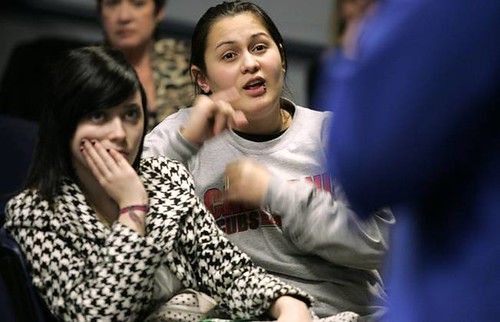
Janeth Gastelum, a student, signs a question to representative from Gallaudet University

Image caption: Janeth Gastelum, a Liberty senior, asks a question Thursday during a presentation by a representative from Gallaudet University, an undergraduate liberal arts university in Washington, D.C., for deaf and hard of hearing students.

At Liberty High School this week, the queries came in rapid succession for Nick Gould, a recent graduate of Gallaudet University, the world’s first higher education institution for the deaf: How big is the college? How many dorms? Are there varsity sports? What about scholarships?

Gould, who travels the country on behalf of his Washington, D.C., alma mater, answered in sign language. […]

Gould said Gallaudet “is a place where we can thrive with our deafness, instead of running around it. I don’t think any other university in the world offers that.”

Asperger Square 8: Curing Autism

What I am wanting to say here is twofold. Sometimes the cure is worse than what one is seeking to alleviate. Alcohol allowed more words to flow, but the words were not good ones. They no more represented my true self than my silence had.

jonquil at Rosemary for Remembrance: Nothing was learned [post includes warning: ” triggery for cancer survivors I MEAN IT “]

This is the classic teaching case for engineering risk. Anybody associated with medical devices ought to have heard about it. The lessons learned were clear-cut, one of the most significant being that any such device ought to have a mechanical, non-software-controlled, interlock to prevent its operation with no shields in place.

hkfreeman at The Living Artist: Quick Rant

Stop telling me to go see Avatar in IMAX/3D. […] Think about that next time you ooh and ahh over some new technology. Is it new technology for everyone? Or just those privileged with a culturally approved set of sensory organs?

KTVU.com: Judge Rules Disabled Can Use Devices During Bar Exam

A federal judge in San Francisco ordered a national bar exam organization Friday to provide technological aids requested by a blind law school graduate who plans to take the test next month.[…]

[Stephanie Enyart] said that in order to read material on a computer effectively, she needs a combination of magnified text and a software program that reads portions of the text aloud.

The California State Bar agreed to allow her to use the technology combination for a portion of the exam, but the National Conference of Bar Examiners refused to allow her to use it for two other sections controlled by the national group. The group contended that Enyart’s plan would endanger security of the material and that other accommodations it offered would meet the requirements of the U.S. Americans with Disabilities Act.

The adaptations offered by the conference included a human reader, a scribe to write down her answers and/or magnified text.[…]

Outside of court, Enyart said, “I’m glad I now have the luxury of just worrying about the bar exam itself”.

Miami Herald: Disabled teen’s dad wins fight over diaper costs

This week, a federal judge ruled that, for Florida children like Sharett [age 17], diapers are a medical necessity — not a “convenience” — and ordered the state Agency for Health Care Administration to pay for them. The ruling could affect thousands of sick or disabled children throughout the state. […]

Smith, of Miami, is raising Sharett and two other young children on about $1,000 a month in Social Security disability and survivor’s benefits. His wife of 26 years died of a brain tumor. The $200 to $300 he spent each month for diapers for Sharett represented 20 percent or more of his budget.