Daily Archives: 17 December, 2009

For Cereal, Internet?

A periodic feature in which we highlight some of the more ableist posts and comments in the blogosphere – the things that made us throw up our hands and ask “FOR CEREAL???” *

Today’s edition: a post at Jezebel titled “Woman, Go Take Your Pills!”: Schoolgirls Respond To Samantha Bee’s Christmas Conspiracies. Which, already – are you for cereal, Jezebel? The post reviews a Daily Show segment in which Samantha Bee meets with schoolgirls and, in the tradition of the Daily Show, presents outlandish and absurd positions to them as serious arguments. For example, she tells them that she doesn’t believe that Obama was born in the United States. The humor in the segment is the shocked and outraged responses from the schoolgirls to these positions and arguments.

At one point in the segment, one of the schoolgirls tells Bee “woman, go take your pills.” Which is problematic for a whole slew of reasons – the assumption that irrational or absurd political arguments are a sign of underlying mental illness, the assumption that medication is an appropriate treatment for all mental illnesses, the assumption that bystanders have a right to dictate the treatment a person pursues or receives for a mental illness. But none of these problems seem to have occurred to Anna at Jezebel, who chose the phrase to title the piece.

And the immediate response of commenters wasn’t to push back against this ableism, or to explain why using such a phrase is problematic, but to embrace the phrase as their “new smackdown,” per boobookitteh, or celebrating the “straightforward verbal beatdown these girls delivered so awesomely,” per BillyPilgrimisnotmylover.

So I award a “FOR CEREAL?” to Jezebel for approving of the phrase and using it to title their post, and a second “NO REALLY, FOR CEREAL?!” to the commenters for enthusiastically embracing this offensive phrase as their new go-to insult.

*(Actually, what I say, and what I considered titling this, is “Are You Fucking Kidding Me With This Crap, Internet?” but I’m trying to use less salty language.)

“Bad Activist” moments

I read a blog post recently by a woman with muscular dystrophy and her experiences going out to eat in restaurants. The author mentioned how wait staff rarely give her a menu, or give her a children’s menu instead of the standard menu. When this happens, she often just looks on with her mom’s menu rather than asking the wait staff to give her her own adult menu. She described that as a “bad activist moment.” While I enjoyed and appreciated the rest of the post, and marveled at the ableism she routinely experiences – wait staff giving her a sippy cup to use?! – the idea of “bad activist moments” particularly stuck with me.

A “bad activist moment,” if I understand it correctly, is a potential opportunity to highlight ableism, educate TABs on the abilities of a PWD, and instruct people on the correct way to interact with a PWD. It could also apply in other contexts – the opportunity to highlight and correct patriarchal or sexist behavior, or racist behavior, or ageist behavior, or any number of other discriminatory and oppressive behaviors. In this context, the person experiencing or observing the problematic behavior is a member of the class negatively affected by such behavior, but it could also, for example, extend to me as a white woman observing behavior that discriminates against Latinos.

I definitely think this idea has value and recognize that the term “bad activist moment” is likely shorthand for “an identifiable moment of opportunity for direct personal activism that I didn’t take” rather than a judgment on whether the person is actually at heart a good or bad activist. But I’m concerned that framing it as a “bad activist moment” suggests that to be a good activist, we must speak up and speak out Every Single Time we observe negative behavior, not just that affecting PWDs, but that affecting or oppressing any minority group or marginalized class. I know that I do not do this and if I did, I would likely suffer significant consequences. I feel I’m already on the edge of being characterized (and thus dismissed) as the girl who has a problem with everything and is hyper-sensitive on these issues and cannot in any way ever take a joke ever – and that’s with me pointing out about 1 in ever 10 problems I see. I worry that if I devoted more time and energy to those issues, I’d be pigeonholed as “politically correct girl” and nothing I said would be taken seriously or considered.

More seriously, though, it is infinitely more risky to raise issues of discrimination and oppression when you are part of the group that is being discriminated against or oppressed. Not only might this require someone who is “passing” to identify and out themselves, but explicitly claiming membership in the targeted group can lead to further discrimination and marginalization. In the racial context, it’s often characterized (and thus dismissed) as someone “playing the race card.” I’m not aware of a similar term in the disability context, but the trope of an “uppity” activist who “thinks they’re entitled to something” extends to all oppressed or marginalized groups. Identifying as such opens a person up to further attacks and discrimination and even physical violence.

Even without these very real risks, I believe that we should all allow ourselves the option to pass up potential opportunities for activism while still considering ourselves to be good and powerful activists. Even if all we did was live our lives as PWDs, that in itself would be an activist act, demonstrating that PWDs have interests, passions, relationships, emotions, LIVES. We would qualify as activists even if we passed up every single potential opportunity to do affirmative activism work.

My ultra-wise co-contributor Chally once told me that taking care of myself was a feminist act. Placing myself at the top of my priorities – even though I am a woman and “should” prioritize caring for others or building a family, even though I am a PWD and thus “have minimal value or worth to society” – is an act of activism. Can I do more than that? Yes, and I do, but I always try to keep in mind that my activism is and should be secondary to my own well being. In part because I’m not going to be able to do any activism at all if I burn out or hurt myself physically or mentally doing activism work. But also because the simple act of prioritizing myself is, in itself, activism.

So take the opportunities for activism that you feel you can. And let the others go by. And remind yourself at the end of each day that you were a good activist that day.

Recommended Reading for December 17

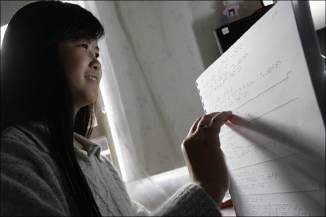
Ria Andriani reads from a Braille board

* Sydney Morning Herald: Blind student tops HSC subject

Ria, a blind student who topped NSW in Indonesian Background Speakers, only migrated to Australia from its northern neighbour in 2007.

Unable to see since she was five, the student from Sydney’s Open High School has been proficient in Indonesian braille for many years.

But after moving to Australia, the inspirational teenager not only had to learn English but English braille.

[image source]

* Wired: Obama Sides With Blind in Copyright-Treaty Debate

The Obama administration announced Tuesday it supports loosening international copyright protections to enable cross-border distribution of special-format reading materials for the blind, a move that puts it at odds with nearly all of U.S. industry.

The government announced its support for the underlying principle of the WIPO Treaty for Sharing Accessible Formats of Copyrighted Works for Persons Who are Blind or Have other Reading Disabilities.

* Knowledge Ecology International: “Who on earth would oppose a treaty to facilitate access to information and knowledge to people with reading disabilities?”

This article outlines and excerpts a series of responses to the proposed copyright treaty, including the posturing by the MPAA [Motion Picture Association of America] and RIAA [Recording Industry Association of America], as well as more sensible responses from the Electronic Frontier Foundation (EFF) and other groups.

* King5.com: Outrage over handicapped parking signage

[posted purely so you can play Accessible-Parking Ableism Bingo! with the comments. How high can you score?]

Disabled & Sick: We’ll Manage

Don has Marfan’s syndrome. It’s a genetic condition that he was born with. It’s the cause of his height (he’s 6’10” tall, 2.09m), his overall build, the way his fingers are shaped. It’s also the cause of his intense chronic pain, his wheelchair use, and his risky heart condition. It’s a spectrum condition – some people don’t have the chronic pain, but do have serious issues with their eyes. Some people don’t know they have Marfan’s until they have an aortic aneurysm and drop dead at 22 with no warning. Don grew up thinking he wouldn’t make it to 25, and his 30th birthday is next month.

Don also has Cancer. His cardiac specialist noticed the lump in his thyroid last year, before his serious ear-related surgery [1. I like to joke about his having too many holes in his head, but it turns out the problems with his mastoid were so bad that he could have died from a brain infection. Don’s health is never having to say you’re exaggerating.], and the whole thing’s been weaving its complicated way through Nova Scotia’s health care system ever since. He had surgery to remove his thyroid in September, with a doctor who assured us not only that there should be no problems with his surgery [2. Don can no longer speak above a whisper.], but that he should fully recover in a week or two.

Don still hasn’t recovered from surgery.

My mental jury is still out on whether or not Cancer is a disability. I think Susan Wendall makes a pretty good argument for it, by talking about how people with Cancer go through both social stigma and a lot of pain of treatment, but I admit to not knowing anyone with Cancer who’s described it as a disability, and I’m big on self-identifying. In this case, though, I’m going with Cancer = sick, because it’s allegedly cured. Everything’s fine now.

Except for the bit where none of the doctors along the way have known how to deal with Don’s disability at all. It’s like they somehow missed “Disability 101” in Doctor School.

We had the doctor who decided to start bending Don’s fingers back with no warning, discussion, or permission, apparently just to see how far they’d bend back. How this is relevant to a thyroid consultation, I don’t know, but Show & Tell Marfan’s Syndrome is pretty shite behaviour when one’s waiting for a Cancer diagnosis. Similar stunts have happened so often – bringing in additional students so they get a chance to “see a classic Marfan’s Patient”, like he’s a specimen in a zoo, or having Don’s classic Marfan’s features pointed out and discussed at length, as though he’s not right there.

The technician who did Don’s chest x-ray (to make sure there were no clots of Cancer in his lungs) baby talked to him, we can only assume because of the wheelchair, since we haven’t been able to get anyone to actually acknowledge that happened, let alone that it was a problem.

When he went in for the ultrasound on his neck… Oh, gosh, where do I begin? With the wheelchair inaccessible waiting room (you can wait in the hall!), or the refusal to allow Don’s wheelchair to even be in the room when he was being examined? As though able-bodied people are asked all the time to leave their only means of getting away behind. Plus, you know, the refusal to believe either of us that it’s common for people to play Show & Tell Marfan’s Syndrome.

And then there’s Doctor Fail. Oh, Doctor Fail, I hate you so much. The fast recovery time you assured us would happen, even when we both emphasized how long it took Don to recover from surgery previously, because he has a chronic pain condition. The bit where you prescribed far too low a dosage of thyroid replacement medication for someone of Don’s size, to the point where his energy levels dipped so badly he couldn’t handle reading fanfic because the plots were too complicated for him to follow, and he couldn’t get out of bed at all. [3. The radiologist increased his dosage to five times the amount. That was weeks ago. He’s still recovering.] Or, hey, the bit where you insisted that all mailed-out appointments needed to be confirmed by phone – despite knowing that Don can’t talk on the phone anymore because of the damage your surgery did to his vocal cords.

The latest round of fail is the radiation therapy he needs in post-Cancer treatment. I don’t even know how to describe the level of care he will need for this. They will need him to come right back off the thyroid meds. They need him to not be within 6 feet of anyone for any length of time. They need him to shower every single day, and then clean the shower out immediately. They need every plate he touches to be washed immediately, and all of his clothing washed immediately after taking it off.

When Don tried to point out that this is not something he can do, even when his thyroid meds are working just fine [4. Don has a homecare worker because normal showering and the like isn’t something he can currently do without aid], the response was a very cheerful “Oh, you’ll manage!”

Y’all, we are not managing. I can’t tell you in words how much we are not managing.

If we were a household of two able-bodied people, these would still be problems, but they wouldn’t be as overwhelming and dangerous as they are. If we were both two people who didn’t have mental health conditions [5. Don has Chronic Depression/Unipolar Disorder something-or-other, and I have a diagnosed mental health condition that I chose to never speak of on the internet because even the comments here at FWD include people who have merrily informed one and all that women with my mental health condition are bad.] this might be a bit less dire than it is. But as it stands, this has become a very very serious problem, and one that the medical people we are dealing with seem completely unable to address at any level, or any point.

The latest, today, was the psychiatrist telling Don to just wait things out and see if the anti-depressant that hasn’t been working for months suddenly kicks in, so the suicidal thoughts and horrible guilt at “what a burden” he is (he’s not!) both go away. Like magic, I guess. Because it’s normal, I guess, to be depressed, disabled, and Cancerous, so we shouldn’t treat it.

Our family has been in a pretty bad state for months now, because of so many people along the way, including us, assuming we’ll manage, somehow.

The support services designed for families ‘dealing with Cancer’ are not designed to include families like ours. Don can’t leave the house much, because it’s winter, and uncleared snow can be a problem. I’ve been so swamped that I’ve been out of the house for 18 hours a day at least four days a week. Support groups and services don’t seem to consider ‘wheelchair’, ‘mental health condition’, ‘complicated family situation’.

And so, here we are. I don’t think this is some tiny crack we’ve managed to slip through, but a big gaping chasm that has a bridge that’s passable only if you’re “general population”.

I honestly don’t know what we’re going to do. I guess we’ll manage.