Monthly Archives: October 2009

Ableist Word Profile: Intelligence

Welcome to Ableist Word Profile, a (probably intermittent) series in which staffers will profile various ableist words, talk about how they are used, and talk about how to stop using them. Ableism is not feminism, so it’s important to talk about how to eradicate ableist language from our vocabularies. This post is marked 101, which means that the comments section is open to 101 questions and discussion. Please note that this post contains ableist language used for the purpose of discussion and criticism; you can get an idea from the title of the kind of ableist language which is going to be included in the discussion, and if that type of language is upsetting or triggering for you, you may want to skip this post.

Wait! you may be saying to yourselves. Kaninchen Zero, what the hell is ‘intelligence’ doing in the Ableist Word Profile series? Intelligence isn’t a disability!

Okay, so maybe you’re not saying that. But I’m serious. I hate this word. Hate the concept. With a hatred that is a pure and burning flame. True, part of this is because I get told all the time that I’m like wicked smart. When it’s some of the more toxic people in my family saying it, there’s more to it: You’re so intelligent so why are you poor? Other people use it as an opportunity to put themselves down: You’re so smart; I’m not; I could never do the things you do.

Does intelligence exist? At all?

Maybe it doesn’t.

There are tests that measure… something. They’re called Intelligence Quotient tests. The idea is that these tests actually measure some fundamental, real quality of human cognition — the people who believe in IQ believe that there’s a single quality that informs cognition as a whole and that people who have higher IQs have more of this and think better and perform better generally while people who have lower IQs have less of this quality and perform more poorly. Sorry; it’s a muddle of a definition, I know. Partly it’s a conceptual and linguistic problem — some things are not well defined and these things tend to be the things we consider to be fundamental. It’s much easier to define smaller things at the edges; it’s easy to define a fingernail. It’s harder to point to where blood stops flowing away from the heart and starts flowing back towards it.

The man who developed the first intelligence tests, Alfred Binet, wasn’t actually trying to measure intelligence. He’d done some work in neurology and psychology and education, and in 1899 he was asked to become a member of the Free Society for the Psychological Study of the Child. Primary education in France had become mandatory, so a lot of work on educational psychology was being done due to the large demand and the large available sample population. Binet, and others, were assigned to the Commission for the Retarded. (Again, please accept my apologies; I wouldn’t use the word if it were mine.)

The problem he was trying to solve was how to identify — consistently, without having to rely on the judgment of people who could be swayed by all sorts of personal biases (as we all are, including me) — those children who needed extra help. Maybe they had developmental disorders, maybe they had learning impairments along the lines of ADD/ADHD, dyscalculias, dyslexias, maybe malnutrition, injury, or childhood disease had caused neurological damage or limited development. The specific etiology wasn’t the point; the point was to be able to know who these children were and get them assistance. Which may be ascribing too-noble motives to him, but he doesn’t do so great later. Continue reading Ableist Word Profile: Intelligence

Yes, it DOES make a difference

(Cross-posted at three rivers fog.)

I wrote this yesterday in an extreme fog and do not have the spoons to rework and polish it. Apologies for the brainspill, but these days it’s the only option I have.

***

For background, see Ouyang Dan’s post on the problematic aspects of the TV show House. Don’t tell me that people realize this is fictional. Don’t tell me that people know how to maintain that separation. Some do. Many don’t. And they’re everywhere. At the bottom of the totem pole… and in positions of power over the very people they are prejudiced against.

***

I was called back to work two weeks ago. I work at a government office that provides certain assistance programs. (Once you go to work for one government agency, you realize there are a whole lot more of them than you ever thought before.) I really don’t want to go into it any more specifically than that.

It’s been very rough on me. Last winter, work was physically draining. I basically have two whole hours every day that I am awake and not at work, preparing for work, or traveling to and from work, and semi-conscious. Not only am I so physically exhausted that I go to bed three hours after work ends, I am so physically exhausted that my brain just cannot be pushed any further. I have trouble comprehending the blogs and news sites I normally read; writing is usually out of the question. Of course, we won’t even talk about anything more physical than that — even preparing a boxed dinner for myself is too difficult. My apartment is even more a mess than usual, because I don’t have the energy to pick up the clothes that I shed as soon as I get the front door shut, the mail and personal items that trail after me from the couch to the bedroom…

Unfortunately, so far this year, it hasn’t just been physically draining. I’ve been dealing with a sudden onset of severe migraines, and not the type of migraines I’ve had since childhood and have an intimate knowledge of — these are more classic migraines, the nausea, the aura and vision distortion, the intense pain and pressure behind the eyes… The pain is not as overwhelming as my normal migraines (where a twitch of the toe makes me want to scream or cry or at least moan, but the movement and force of emitting any noise at all would hurt even worse, so I just curl up and remain frozen in misery), but the experience is just as miserable because it block’s my brain’s ability to function, even to process the smallest of information. I’ve been having trouble writing six-digit numbers on the top of each application. And normally I work faster than the worker next to me, but the past two weeks she’s been cranking out work three times faster than me.

It’s frustrating. I’ve been doing everything in my capacity to do to fight these headaches off. Everything. And no, I don’t want any helpful suggestions. But regardless, even with all the desperate measures I have been taking, they persist.

On top of it all, my endometriosis has decided to flare up at the same time. So I get double nausea, extreme abdominal cramps, persistent pelvic pain and other symptoms.

I’ve been in a lot of pain.

I take a lot of medications. For pain. I take medications that have no effect on people who do not have a specific type of pain disorder. And I take medications that people who are not in pain popularly take to get high. (I do not, for the record, take anything to get high myself.) And I put up with a lot of shit to continue taking one of few medications that works and that enables me to work.

(I guess I could give it up and therefore be putting up with less shit. But then I’d, you know, not be able to work. And for so long as I have the option to be able to work, I’m taking it. Because I may not even have that option forever. Situations change, bodies change, and bodies change how they react to medications over time. I’m doing what is necessary for myself and my family at this point in our lives.)

So, at work today.

I sit on the far side of the first floor of our building, along with all the other people working in my particular program, the people working on another program, and a couple stray general clerks across from all of us. The other program’s supervisor and one of the other program’s workers (OPS/OPW hereafter) were talking about a certain case, a woman who was being denied medication and needed help obtaining it. This was before lunch, it was a general talk in a work context, that is how to get the problem solved.

My husband and I went home for lunch, as we do regularly, given that we live less than five minutes from our workplace. It takes half the lunch period but it is worth the spoons because it makes the workday so much more bearable — two four-hour chunks rather than one long nine-hour one. We sit around, watch The People’s Court reruns, eat our lunch and laugh at the cats who get in silly, hyper, meddling moods around that time.

I returned from lunch, feeling a lot better having had a break from the fluorescent lighting and ambient noise of the HVAC system. And a few minutes after I got back, sitting next to the OPS scanning documents into the computer system, OPW wandered back over and began talking again about the client from before.

The medication? Oxycontin. Her doctor has been prescribing it to her for over 15 years.

And the conversation? Went like this. (As typed soon after in an email to my husband, as close as I could get to what they actually said, given how stunned and hurt I was while it was happening.)

OPW: do you watch house?
OPS: no not really
OPW: well he has some sort of leg injury, but he takes that other one, what is it? vicodin
OPS: uh huh
OPW: and they sent him to rehab, and he just had to find something to occupy his mind so he wouldn’t think about it
OPS: yeah they get addicted so easy
OPW: and now they put him on regular pain killers and he’s doing just fine
OPS: yeah a lot of the time tylenol or advil works just as well, people just want the high
OPW: exactly, and their doctors prescribe it to them and they hand it out to family members…

And the conversation went on like this for a couple minutes, with the two of them walking back and forth fetching printed documents, attending to the scanning etc.

I just… I’m not terribly private about my condition. I don’t bring it up, but if it’s relevant I talk about it. I do try to avoid telling my coworkers that I take narcotic medications (as opposed to just “medications”) but I have gone over it specifically with HR as it can be a security issue in some agencies.

I was sitting right there. OPW sits on the other side of me, and had to walk around me to get to where OPS was at the scanner. I was sitting right there.

They were talking about me.

They weren’t thinking of me, of course. They’d never make that connection. I’m young and thin and pretty enough. They know I work hard. Most of my office loves the hell out of me.

But if I had spoken up — rather than sitting there holding my breath trying not to cry — how would that opinion change? Would they start seeing me as lazy, as slacking off? Would they whisper about me every time I went to the water fountain for a drink? What was I taking? What was I doing with it? Would they start taking certain behaviors as symptomatic of addiction? If I passed too well one day, appearing to be just fine (to them; I am good at covering up my pain) — would they take that as evidence that I couldn’t actually be in pain and couldn’t really need that medication? And if I didn’t pass well one day — especially these days, when I’ve been stopped more than one time as someone remarks on how deathly pale I am and asks if I’m OK and tells me to take a break — would they see that resulting, not from my pain, but from the supposed addiction?

They were talking about me. They didn’t even know it. But I am that person on that medication. Pushing through the pain to keep working.

The difference is, Dr. House is a character.

I’m real.

And that woman. These were the attitudes of the people who were helping her resolve an issue. As much as I wish otherwise, workers do have some degree of latitude in deciding how they are going to approach a case, and can apply the law in different ways for different people, even if it appears pretty strict on paper.

I am that woman.

I have been there. I am there. I have to deal with unsympathetic figures in obtaining my treatment. Doctors, nurses, office staff, pharmacists, insurance reps, welfare reps, other reps. I have issues I have to call to have resolved. I have that person on the other line who’s promising me on the one hand to resolve the issue — but on the other hand …? How can I ever know?

I don’t know what was going on in this woman’s life. I don’t know if she’s dependent (there is a difference). I don’t know if she would be better off on another course of therapy. Or whether she’s tried all those other courses and they’ve given her awful side effects or they’re contraindicated given her particular condition or they’re unavailable to her due to income or access. I don’t know.

Maybe she’s abusing. Maybe she’s handing it out on the street corner.

Maybe she’s just like me. Just one person trying to power through this world as best she can. And this is the best way she’s found to do it.
You don’t have to be normal.

(Originally posted April 2008 in two parts at three rivers fog.)

this is new to me. this idea that i should love my body. not hate it.

it’s funny, because i was about to say “this isn’t a post about body image.” but it is, isn’t it?

let’s cut to the point. i’m not talking about beauty standards.

i’m talking about my body. this physical thing.

i need to stop hating that physical thing.

it works differently. it doesn’t work like your body.

but that doesn’t make it bad.

this is hard to grasp. i don’t like this idea.

but maybe it’s better that i respect my body, and how it functions, than malign it, and Other it, and see myself as working against it.

maybe i need to see my body as that physical thing that is trying to help me be everything i want to be.

maybe i need to understand that i just have to interact differently with my body to accomplish that.

and that is not bad. that doesn’t make me Less Than. that doesn’t even make me different — or it shouldn’t, anyway.

maybe the problem is that i have been so indoctrinated into this culture that i can’t even see myself as just being – it’s always how different i am from the “normal” “healthy” body.

you know what, dammit, my body is “healthy.” my body is damn well fucking “normal” for me. when i understand how to work with it? i live a pretty damn nice life.

but the culture i live in doesn’t allow for that view. the culture i live in says that my body is not only different, but different in a bad way, because it doesn’t let me live my life like a normal person does.

fuck that.

i have a lot to work on, here.

revelation: i wouldn’t have such a hard fucking time learning how to work with my body if my culture hadn’t taught me to expect to be The Norm. if my culture hadn’t taught me that if you look like you’re fully-abled, then you must be. if my culture hadn’t taught me that if it doesn’t show up in the bloodwork or the ultrasound then it doesn’t exist. if my culture hadn’t taught me that my pain is simply pathology. if my culture hadn’t taught me about welfare queens and “milking the system.” if my culture hadn’t taught me that disability is both scary and pathetic.

…maybe i just need to understand that this is how my body works and damn it all, there shouldn’t be anything wrong with that — the fact that there is anything “wrong” is a sign of a fucked up culture — not of a fucked up body.

***

…the person who believes ‘I will be real when I am normal’ will always be almost a person, but will never make it all the way.

Eugene Marcos (via, via)

We have been told all our lives that to be accepted, to be successful, to be a whole person, we have to be “normal.”

And so we strive to change ourselves such that we resemble normalcy.

But it is a rare bird that can adapt itself to living in the water — or fish that can adapt itself to fly.[1. I hesitated with this metaphor. I was afraid of the implications. The usual stuff, that pwd are of an entirely different species, that pwd are animals, that pwd are at base un-understandable and therefore nobody should even try. (”We are nearer still when we know we don’t have to understand somebody to know he is real.”) But at the same time, I don’t want to shy away from the implication that we are not all the same. That is what we are pushing to accept. Everyone approaches the world in hir own way, and that is ok, and we don’t all have to come from the same place to be able to travel together.]

Respect your body and your mind. They operate how they operate, and there is no need to change that, not for anyone’s sake. It is not a deficiency. It does not make you lesser. It is not deviancy. It is what you are, and it is good for you.

People on the outside will be uncomfortable with the implications of such a weird and different body (mind) being a good thing, because we have all been indoctrinated into the cult of dominance, where what dominates is Good and Right, and anything that is not the same is Bad and Wrong. It manifests itself in so many different ways even for the same differences. But that is the root of it.

To outsiders, the idea that what you are is definitionally good, because it is good for you, a different person, is disturbing. To outsiders, it says that then, what they are must be bad. And those who think that way will therefore reject you as a person, differences and all.

But there is a different way. There is a way built, fundamentally, on respect. On allowing one another to be what we are, and finding joy in what results. On knowing that when a person falters trying to live in this society, it should not be chalked up to the fact that they are different, but to the fact that society has failed to plan for anything but the dominant, and will then fail in trying to accommodate anything else.

It rests on, again, seeing a person and thinking not: burden, but: potential.

On seeing that person, and recognizing them as a person.

We should all be prepared to accommodate differences, even when it means a change or an extra effort. We should be prepared for this, because we expect as much already from those we are failing to accommodate. We already expect them to change their very being to be able to accommodate how we operate. So we should not protest when we are called upon to open our minds, to change how we think, to change what we do. After all, at least we are not being asked to change what we are.

Shifting the Responsibility for Disability in Uniform

Moderatix note: This post will be United States Military centric, as that is the perspective I offer, and the broken system within which I currently exist and attempt to navigate.  Other voices are welcome and experiences appreciated within the context of the conversation, since I can not pretend to know every thing about every military experience from every branch in every country.

Disability issues overlap many facets of life, and one of our goals here at FWD is to bring as many of those to light as possible.  One voice I want to offer here is that of the disabled U.S. Veteran.  Specifically in feminist circles I feel that the disabled veteran is a voice that is seldom heard, and while hir voice may be part of a very small percentage, sie is facing a unique set of challenges.

One of those challenges is getting a diagnosis and care in the first place.  A person gives hir time and life to the military for one of a variety of reasons and find hirself trained for any number of jobs.  Sie can travel the world, see exciting places, or be sent off to fight in wars.  In the blink of an eye hir world is turned upside down.  Suddenly life isn’t what it was before.  Hir body/mind/soul are not what they once were, and coming to terms with that is no easy task.  If sie is one of the ones who has survived combat injuries or someone who became sick or injured while doing hir job in a Stateside base, sie does what sie has been taught to do…sie makes a routine appointment at the local Military Treatment Facility (MTF) to see her Primary Care Manager (PCM).

Hir PCM might evaluate hir, refer hir out for tests with specialists, or set hir on a merry-go-round of treatments.  When the ride stops sie may or may not have any answers, and there may or may not be a Medical Review Board pending to tell hir the terms of the future of hir career.

This is where things get interesting.  By interesting, I mean kind of fucked up.  One, any or all of those specialists might have diagnosed hir.  Those doctors start treating hir accordingly, because while TRICARE (military medical insurance) has its flaws, it kicks a lot of arse, and sie gets the care sie needs, mentally and physically (until her PCM deploys, but that is another post altogether, just you wait!), all under the umbrella of hir diagnosis.  But then the Medical Review comes up, and all of hir doctors have to write these recommendations, and suddenly things change in terms of hir care.  In hir appointments hir doctors start getting vague about care plans, and start talking around the actual words for hir condition…sie might suddenly feel dismissed or as if hir questions are not being answered.

As we read earlier this year, it isn’t a coincidence that military doctors are getting dodgier than Sarah Palin in an interview.  There seems to be pressure to not diagnose active duty personnel while active duty, and it isn’t just PTSD.  This service member might have received treatment for months leading up to hir review board only to have hir diagnosis revoked for the board so that the military could discharge hir with a lower rating.

It’s not too hard to understand why this happens.  The rating system breaks down a little like this:

A medical team of medical officers somewhere in Officer Land and look at your whole military medical record, and all these nifty letters written by the doctors who have seen you, along with some reports from your Chain of Command (CoC).  Based on all of this information they determine whether or not to separate you from the military.  They also give you a percentage rating of how disabled they think you are before discharging your from the military (there is also something called Permanent Limited Duty, which I can talk about sometime in another post).  It goes 0%-100% (the percentage is ultimately the amount of money they give you and “how disabled” they think you are).  Unless they give you at least a 10% rating you get nothing.  There is a list somewhere of what constitutes what percentages, and the military’s is different from the VA’s and each branch seems to interpret it differently.  Anything between 10 and 20% will grant you a one time award (I love that they use the word “award”, like somehow you have won a prize) based on your pay over the number of years you spent active duty (minus taxes, but including any bonuses you earned).   Most medical review boards fall in this range.  The magic number seems to be 30%, which gives you a monthly stipend based on the same numbers.  This math works all the way up to 100%.  After 80%, however, you receive what is called a Medical Retirement, which, regardless of how many years you have served, you retain your full benefits (insurance, commissary, exchange and medical) as if you had retired after 20 years of service.  That, I think is the rub.  It’s money.

When I had my review, it went a lot like that as well.  I could have been Sgt. X (well, Petty Officer X) in the rheumatologist’s office w/ a tape recorder.  The same guy who had written in my record that he was treating me for fibromyalgia had written in my medical review that there was no way to know for sure, that I could in fact have fibro, but that I could also have CFS, or PTSD, or just be really depressed, so there was no real answer.  His best advice was for a medical discharge and a referral to the VA for follow up care.  He also suddenly became angry because I didn’t want to be on Cymbalta, because I didn’t feel the need to be on another anti-depressant when ADs weren’t helping my pain (Lyrica wasn’t out yet, and Cymbalta was a new-ish treatment).  When a doctor tells me “I guess you don’t want to get better”, without listening to my concerns I know I have lost a battle.

After my review board findings came back (10% if you are nosy), my doctors seemed to have a shift in my care.  I was receiving less pain management care (well, less pharmaceutical) and the focus was more on mental health.  My review board found that I was too depressed to continue with active duty service, oh, and Trichotillomania sounded weird, I guess, so they tossed that on there, even though no one gave a fuck about it before.  Pretty much all of my care was to be managed through Mental Health (which, should be noted, is in no way a slam on mental health.  In my case, it was not the treatment I needed, even though for some people it is what they need), which made my physical needs very difficult to acquire while I was still active duty.  Yes, I was depressed, but I was depressed because I was in so much pain that I was having a hard time dealing with life and a child, and because no one was listening to me.  I was not in pain because I was depressed.  No one seemed to be interested in the sequence of events.  Before my review board findings I had a PCM, a neurologist, a rheumatologist, a chiropractor, an internal specialist, and a pain management specialist all convinced that all signs point to fibromyalgia.  Afterward you could have dropped a pin in room of crickets for the voices that came to my defense.

After my discharge I began the process of filing the VA claim.  It is pretty much the exact same process, minus the stuff from the CoC.  Oh, and it takes longer.  Hmmm.  I wonder why that is.

I firmly believe in my heart that military doctors (and doctors employed by the military) are being pressured to push us out the door and to let the VA sort us out because it is easier on the budget.  The Armed Forces Committee seems content to thank soldiers by one-lining them out of the fiscal year’s planning, and it pisses me off.  When I was given my board findings and told to sign off on it I was able to glance at the list of others who had been reviewed with my own.  I remember seeing at least a dozen names with finding for PTSD or other things that are “invisible”, all with a 10% or lower finding.  Brothers and sisters who have served their country, and this is the thanks we get when shit didn’t go as planned.  I know that this is happening to many service members, military wide.  I know that this is happening because our disabilities are invisible and easy to dismiss.  Veterans are slipping through the cracks, and Congress and the DoD is not only letting it happen, but damn well encouraging it.

This is the first in what will hopefully be a series of posts on navigating disability in the military health care system.

Recommended Reading for October 22, 2009

In the blogs:

Chronic pain management is not addiction

For me, addiction is an issue because it does run in my family, I do have mental health issues which can lead to substance abuse/addiction, and I find I actually do have the “addictive personality” in some ways. I also need regular, and somewhat large, doses of narcotic meds just to be able to function at the low levels I am able to – and frankly, to stay alive because the pain I would be in without the help would absolutely lead me to suicide.

This does not make me an addict. It makes me physically dependent on a medication for survival due to a medical problem. You know who else that description fits? Some people with diabetes who need insulin to stay alive, some people with heart disease who need medication to stay alive, some people who have had organ transplants who need medication for their organs to keep functioning, and the list goes on forever. These people are not considered to be addicts. And neither am I.

What’s the Deal With Disability? is a new forum for people with disabilities to discuss their interactions with the public.

SAD

It turns out that among the other endless list of depressive, mentally draining, physically exhausting, unable to think clearly, scatterbrained SHIT going on in my body–I also have SAD, or seasonal affective disorder.

I’ve been thinking for years about getting that magic light that everybody in the North talks about getting right when winter starts–but–just never got around to it. This year I’ve felt a lot better though, I’ve been getting various types of treatment for various bullshitty horrible things (depression, hypothyroidism, ADD, blah blah blah. UGH!) and I made it through the summer feeling relatively normal. So when early Fall hit…then September…then October started with it’s bullshitty cloudy days that last for weeks at a time…I really felt it hard.

In the news:

Via Unusual Music: Woman suffering from seizure arrested for assault:

Imagine calling 911 for medical assistance and winding up in jail. That’s what happened to a South Side grad student who says, instead of providing treatment, paramedics had her arrested. CBS 2’s Derrick Blakley reports.

Kourtney Wilson, 23, was charged with assaulting three paramedics. But Kourtney says that’s impossible because she was in the midst of a seizure. And she says, what she deserved was treatment, not a trip to jail

CFS/ME and “faulty illness beliefs”: The incredible hubris of the psychiatro-patriarchal complex

This post was originally posted on March 19, 2009 at Hoyden About Town.

New Scientist this week published an interview with infamous psychiatrist Simon Wessely. Wessely persists in believing, in the face of all the evidence, that Chronic Fatigue Syndrome/Myalgic Encephalitis (CFS/ME)* is a uniquely UK/American psychological condition caused by internet-triggered “faulty illness beliefs”.

Here’s a bit. Read the rest at the link.

Mind over body?

Can people think themselves sick? This is what psychiatrist Simon Wessely explores. His research into the causes of conditions like chronic fatigue syndrome and Gulf war syndrome has led to hate mail, yet far from dismissing these illnesses as imaginary, Wessely has spent his career developing treatments for them. Clare Wilson asks what it’s like to be disliked by people you’re trying to help.

How might most of us experience the effects of the mind on the body?

In an average week you probably experience numerous examples of how what’s going on around you affects your subjective health. Most people instinctively know that when bad things happen, they affect your body. You can’t sleep, you feel anxious, you’ve got butterflies in your stomach… you feel awful.

When does that turn into an illness?

Such symptoms only become a problem when people get trapped in excessively narrow explanations for illness – when they exclude any broader consideration of the many reasons why we feel the way we do. This is where the internet can do real harm. And sometimes people fall into the hands of charlatans who give them bogus explanations. […]

Continue reading CFS/ME and “faulty illness beliefs”: The incredible hubris of the psychiatro-patriarchal complex

Disability, Gender, and Poverty

I came across a new study by the Center for Economic and Policy Research, a D.C. think tank, examining the relationship between disability and poverty (pdf).

I was very interested to read this because, while its not discussed in this study, poverty in the United States affects women at rates much higher than men. “The US Census, which uses a comparatively conservative absolute poverty measure, reported in the last decennial census that overall 17% of females, compared to 13% of males, age 18 to 64 living in the largest US cities, had incomes below the poverty threshold. Likewise, 36% of female headed families with children under age 18, compared to 21% of male headed families with children, in the largest 70 cities, had incomes below the poverty thresholds.” For this reason, I think issues of poverty in general affect more women than they do men. Studies have also found that “women are more likely to experience disability than men, particularly disabilities related to mental health,” so the population of people with disabilities living in poverty is likely to have significant numbers of women in it.

According to the study, disability is an enormous factor in poverty. “About half of all working-age adults who experience income poverty have a disability, and … almost two-thirds of all such adults experiencing long-term, income poverty have a disability.” This means that, although poverty is often thought of as an issue primarily affecting Latinos, African-Americans, and other minority ethnic and racial groups, “people with disabilities account for a larger share of those experiencing income poverty than people in any single minority or ethnic group — or, in fact, all minority ethnic and racial groups combined.”

The study gives more information on the prevalence of disability in the overall population, finding that about 18.7% of the non-institutionalized population (excluding group homes, jails, etc)  reported some level of disability. About two-thirds of those people had a disability that “seriously interfered with everyday activities, made it difficult to remain employed, or rendered the person unable to perform or in need of assistance with various functional activities.” Looking at working-age adults over a seven-year period, the study found that “about one in four working-age adults experienced a disability [during the 7 years], but only 10 percent of them were disabled during the entire period.” This supports the view of disability as a dynamic phenomenon that can result in increases and decreases in the severity of impairments over time.

The employment rates for people with disabilities in the United States are strikingly low. Among women age 16 to 64 (considered working-age), about 65.8% of women without disabilities are employed, compared to only 26.9% for women with disabilities. The study attributes this discrepancy to both “the considerably lower rate of labor force participation among people with disabilities and a higher rate of unemployment for people with disabilities in the labor force. This means that women with disabilities are less likely to try to work, but even those who want and are actively seeking work are less likely to find it than women without disabilities. (I should note that per the study, “a number of EU nations — including all Nordic nations –and Canada have higher levels of employment among people with disabilities than the United States.”)

These disability rates and low employment rates have a drastic effect on poverty for people with disabilities. Of those working-age adults who experience poverty for at least 12 months, about half have at least one disability. Of those who experience longer term poverty, defined as at least 36 months of poverty during a 48-month period, have one or more disabilities. This does not mean that having a disability causes a person to become poor, or that being poor causes a person to become disabled, but suggests that there is a strong relationship between the two. A person who is poor and cannot access meaningful health care is unlikely to receive the treatment, aids, and other assistance that would help her to manage her disabilities. A person who is disabled is, as shown above, likely to have difficulty finding or maintaining employment, causing income loss and pushing them towards poverty. Basically, the two conditions reinforce each other and make it more difficult for an individual to address either one.

But we’re not done – there’s an additional problem. The poverty estimates discussed above define poverty using the Federal Poverty Rate, a rate determined by the U.S. Government and adjusted each year. Currently, a single adult without children is considered “poor” only if she earns or otherwise receives less than $903 per month, $10,836 a year. If she has a kid, the family is considered poor only if they receive less than $1,214 a month or $14,568 a year. There are significant criticisms of the current rate, which is calculated primarily on the cost of food and doesn’t account for regional differences in housing costs. Another problem with the rate, though, is that it looks only at income coming into a household and not the necessary costs  – which would likely be higher for people with disabilities, who need medical care, assistants, mobility aids, or other costs to achieve the same level of functioning as a person without a disability.

This means that people with disabilities are “40% to 200% more likely to experience various material hardships than people without such disabilities … among persons living below the current poverty line, a person with a disability would require income of roughly two to three times the poverty line to have the same lower risk of experiencing most material hardships as a person without a disability.”

I read A LOT about poverty and its causes and how it can be addressed through policy solutions and why current policies aren’t working. But the idea of viewing poverty as a disability-related issue is a new one for me. The study explains that this is common, as “contemporary policy debate and research about income poverty in the United States is largely silent about disability… books and papers by leading income-poverty experts and researchers only rarely discuss disability, if at all.” The mention a recent set of papers presented by the Brookings Institute on “high-priority poverty strategies for the next decade” that briefly mentioned disability issues in passing, instead focusing largely on issues of marriage. This is another way the issue intersects with feminism – many contemporary poverty policies are aimed at encouraging poor women to marry or penalizing them for having children, policies based on stereotypes of “welfare queens” or poor women having extra babies in order to collect additional welfare money.

This study makes clear that poverty must be examined and understood through a lens of disability in order for us to create and implement policies that will adequately address the realities. People with disabilities are much more likely to experience poverty than people without disabilities, and the vast majority of people who experience long-term poverty have disabilities. People with disabilities are less able to obtain employment even if they are actively seeking it. And people with disabilities are likely to experience more significant material hardships (lack of shelter, food, etc) than people without disabilities even if both are equally poor according to the Federal Poverty Level.

There is a glimmer of hope in the study, though, showing that this is not an inherent or unavoidable situation for people with disabilities. In fact, the study found that “the U.S. is a notable outlier when it comes to poverty rates for disabilities. The U.S. has a higher income poverty rate for people with disabilities than any other nation in Western Europe as well as Australia and Canada. A handful of nations – again mostly Nordic – have eliminated the disparity in poverty rates between people with disabilities and those with no disabilities.”

So my plan is either to import Nordic social policies or just export myself to Scandinavia. See you in Reykjavík!

Barbara Moore: Feminist, Lawyer, Writer & Grad Student of the U of Melb. 1953-2009

This is cross-posted with permission from the original guest author. It was first posted as a Friday Hoyden feature at Hoyden About Town on September 4, 2009.]

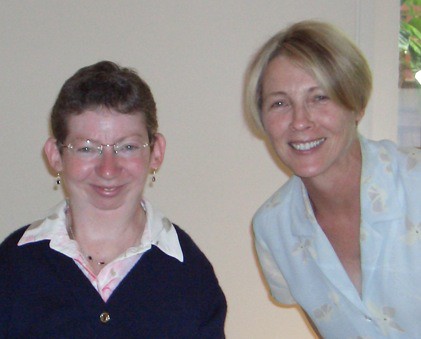
Barbara Moore with her sister AnneThis obituary has been provided by Marion May Campbell, who supervised Barbara Moore’s thesis, The Art of Being a Tortoise: Life in the Slow Lane. The thesis is being edited for submission for a Master of Arts by Research in Creative Writing at the School of Culture & Communication, University of Melbourne. Many thanks to Marion for sharing Barbara’s life with us. Three excerpts from Barbara’s memoir have been included at the foot of the post, with the permission of her family and supervisor.
Image: Barbara Moore and her sister, Anne. [with permission]

Early Life

Born to an Irish-Australian family in the northern Melbourne suburb of Reservoir, Barbara Moore contracted in early infancy a virulent form of infantile rheumatoid arthritis, which went undiagnosed until she was nine. At this stage she was immobilised for ten weeks in a plaster cast, which effectively stole from her much of her remaining mobility. Despite shocking chronic pain, Barbara completed high school and began studies in law at RMIT in the early 1970s, performing well enough there to gain entry to study Law at the University of Melbourne. She persisted with her application, responding with a fiercely defiant stare to the interviewing professor’s question as to whether she thought she had a right to deprive a fine young man of a place. She loved those student years, especially revelling in the companionship and conviviality she found as a resident at St Mary’s College.

After Graduation

After graduation, having gained solid to good honours grades in many subjects, Barbara worked in the Auditor General’s office and later in the Freedom of Information office. While she could still manage limited walking, she drove a car to her city-based work and began to pay off her own town house, her courage and persistence having brought down barriers like her bank manager’s reluctance to offer a loan to a single disabled woman.

In the early 1990s, as her mobility became further reduced through the chronic rheumatoid arthritis, Barbara decided to retire from the Law to devote herself to writing. She enrolled in a Graduate Diploma in Professional Writing at RMIT, where she received an award for her outstanding work. One of her stories about her friendship with an old German priest was made into a superb short documentary film by a graduate filmmaking student. Barbara completed her graduate diploma amassing lots of distinctions for work produced across the genres.

Book cover - The Case of the Disappearing SealsBarbara began writing educational children’s books. Four of these were published by Pearsons, and translated into many languages. She told me, her eyes sparkling with mirth, that her children’s books sold well in Korea and that she was ‘hot in Siberia’.

During this time her condition had worsened to the degree that she had to give up independent living and move into a select retirement home, in which she had her own apartment and wheelchair access to a beautiful neighbouring park. She also was an inveterate poet, ranging from witty, light and nonsense verse to metaphysical conceits of considerable accomplishment. She loved the haiku form, and held workshops for fellow residents.

Master of Arts

It was from here that she enquired about the possibility of doing a Master of Arts by Research in Creative Writing with us at the University of Melbourne in the then Department of English. Initially Barbara didn’t proceed at first, because she was no longer able to type for herself. When the Disability Services Unit offered accommodations in the form of technical and carer’s support, she was delighted to embark on the Master’s the following year. After two years of study, Barbara was awarded the Fay Marle Scholarship, which helped her enormously and gave her a great boost of encouragement.

I agreed to drive out to Balwyn for Barbara’s supervisory sessions once a month, when Barbara’s health made this possible. I was shocked and moved to meet this diminutive woman whose body was severely affected by chronic rheumatoid arthritis. Visible joints were fiercely red, swollen, and twisted. Despite pain always 8/10 and often at 9/10, she was never was able to take painkillers, due to her severe allergies. Yet, here she was, in her cropped auburn hair, brightly dressed in funky earrings and striped stockings, brimming with intelligence and wit, ready to get the maximum out of our 2-3 hour sessions, which always began with a cappuccino and cake for Barbara.

Her project for her Masters thesis, entitled ‘The Art of Being a Tortoise: Life in the Slow Lane’, is an episodic, acutely vivid, at times heart-breaking, but often hilarious disability memoir. Although Barbara did not think the memoir was as polished as she might have liked, I know that what I read was pretty much ready to go, and I believe that Barbara has written at least another 10,000 words since then. The pace was frustratingly slow for both of us, and held up by Barbara’s frequent hospital stays due to accident and infection; however, I thoroughly enjoyed working with her, because of the sheer courage, tenacity and wickedly irreverent sense of humour she always exhibited. It would be hard to find a more fiercely funny feminist socialist than this incredibly spirited woman.

Fighting to Finish the Thesis

A week before Barbara passed away, when she mouthed to me that she was in fact dying, I promised her that I would do this in consultation with her sister Anne Duggan, herself a graduate of Melbourne. Barbara nodded her consent and thanks. It also meant a lot to her niece, Frances Overton, an undergraduate in the School of Education, who has worked devotedly at Barbara’s side every weekend, typing to Barbara’s dictation.

It was only in May that Barbara went into rapid deterioration necessitating what we thought would be respite care for a while, to try to deal with her nausea, reactive depression and acute discomfort. Tragically, it became apparent that something more radical was wrong; the wheelchair was not even an occasional option any more and she lost weight rapidly, alarming for one already so fragile.

Immobilised and isolated over these weeks, Barbara’s great hope was to receive the contract for her book of poetry from Pan Macmillan, that her publisher, Jenny Zimmer, had promised back in March. I assured Barbara that I would telephone Jenny to see what was happening. It was quickly apparent that while Jenny was serious about wanting to publish the work, the global economic downturn had put question marks over the budget. Jenny suggested that a possible subsidy from the University of Melbourne might help. I promised to enquire, knowing that in theory this was only available for staff. Nevertheless Allison Dutke was wonderful making enquiries and paving the way for a possible extenuating-circumstances application. However, I received no reply to phone calls and emails from Pan Macmillan over these weeks and was reluctant to return to the Arcadia nursing home in Essendon with such a bleak tidings. I eventually steeled myself to do so, feeling that I had let Barbara down dreadfully.

It was immediately evident on my last visit that Barbara, who could no longer eat or speak, had little time remaining. I left her bedside vowing to her that I’d do my best to see her poetry published, her Master’s submitted and if possible published as well. On receipt of my urgent email Jenny Zimmer was fantastic and flew into action, despite the budget problems, expediting a contract. Barbara received the news with a smile of great relief and was able to hear congratulations from all the nursing staff. The book, illustrated by Barbara’s Concierge artist friend, Roma McLaughlin, will be launched here in Melbourne before Christmas.

I have just been re-reading some of Barbara’s thesis and her voice is utterly alive across these pages. I am grateful to have had the friendship and inspiration from this extraordinarily courageous, funny and highly creative woman. I am also deeply grateful for the way everyone at the University of Melbourne, from Jessica Rose of the School of C&C, Mathilde Lochert the Manager of C&C, to Matthew Brett of the DSU, and Allison Dutka, who all showed extraordinary patience and sensitivity to Barbara’s predicaments and her ‘life in the slow lane’. I dearly hope that her published work will be an enduring testimony not just to this woman’s brilliance, but also to the immense support that her efforts attracted at the University of Melbourne.

Excerpts from Barbara Moore’s memoir, The Art of Being a Tortoise: Life in the Slow Lane

[Click through to read the excerpts.]
Continue reading Barbara Moore: Feminist, Lawyer, Writer & Grad Student of the U of Melb. 1953-2009

The Negative Side of Positive Thinking

“I don’t have time for positive thinking. I spend all of that time thinking negatively.” –Kathy Griffin

I might as well come right out and say it: I highly dislike the whole positive thinking movement. I would say “I hate it,” but that might get me accused of being bitter, cynical, negative, and many other colorful things in the comments. I do not dispute that I am, at times, all of those things. However, the fact that so many people take the construct of “positive thinking” as the big-T Truth on how people other than themselves can (apparently) improve their own circumstances by thinking “positively” is something that I find very troubling and a little bit scary, and also a bit naive.

You’ve probably heard of positive thinking and its (supposed) benefits. You’ve also probably heard of things like The Secret, which is a self-help book and DVD (and they have other products, too, including a daily planner and something called an “affirmation journal”). For those of you who have had the good fortune to not have come into contact with The Secret, the basic premise is something that sounds pretty innocuous at first, if you don’t examine it too closely or think about it too hard: there is something called “the Law of Attraction,” which posits that the individual can attract their own good or bad circumstances in life just by thinking about them.

I want to stress the part about the “bad circumstances” here. If you swallow that bait–which, like most bait, conceals a dangerous trap–here is what you are buying into: I can attract good things by using my thoughts. If I think positively, I will attract good things.

However, the other side of such a dichotomy is–to put it mildly–really creepy, at least for those of us who have health issues and other problems beyond individual control. I will use myself as an example here: I have fibromyalgia. According to the dubious logic employed in The Secret, I have somehow attracted this. And, according to The Secret, I can think my way out of it. I can be CURED!

Oh, wait. My condition does not have a cure, and thinking one’s way out of a chronic condition is generally not recommended by certified medical professionals. However, according to the “Law of Attraction,” if I don’t think my way out of my condition, or can’t, then I basically deserve whatever happens to me. I brought it on myself, after all.

Therein lies the problem: This type of philosophy places an untoward emphasis on the individual: You control your reality. You control what happens to you. You control how much money you make. You deserve the best. Solving problems or helping others is beneath you, because it is all about you. You’ve got the world on a string, (sittin’ on a rainbow!) and it’s yours for the taking. Why help others, when you can just attract everything you want with your thoughts?

By now, you are probably starting to see exactly why this way of thinking is so troubling, particularly if you are a feminist, have a disability, are aware of social justice issues, or are not C. Montgomery Burns and therefore obsessed with your millions (and not much else).

What is so problematic about The Secret and many other self-help products is that they, however indirectly, make the status quo feel better about itself. People who buy into the “Law of Attraction” philosophy are not actually changing the world; no, that would take actual work. Instead, sayeth the Law, why not just think about changing the world, and let The Secret’s specious (and incorrect) use of quantum physics do the rest? See? Wasn’t that way easier than, ugh, going out and doing things?!

Telling someone to just “think positive” will not help her or him. I know that’s a rather harsh statement to make. I have had people “helpfully suggest” positive thinking (numerous times, I might add) in order to help with my illness. It is supremely frustrating, and it also makes me want to ignore whomever has offered that particular fool’s gold nugget o’wisdom. I get that people are scared of illness, disability, and death, and I understand why they are scared. But shaming people–particularly those with disabilities, chronic pain, mental health issues, and other chronic conditions–into silence by “helpfully” suggesting that they “think more positively”–and thereby shutting down the conversation or any room for the PWD to defend hirself–is not a solution. Rather, it just reinforces the it’s all about me claptrap that so much of the self-help industry traffics in; such “helpful suggestions,” oftentimes, are really meant to make the person who offers them feel better about hirself, and are not offered out of concern for the PWD or whomever else is unlucky enough to have been outed as a non-Positive Thinker.

After all, when someone offers those types of “helpful” suggestions to a non-Positive thinker–particularly PWDs or other people who have been marginalized by various cultural institutions–what she or he is saying starts to sound like, “I don’t take your experiences seriously. I care about expressing my opinions about your life and how you live it, so I can feel like I’m doing something and thus feel better about myself.” So, in effect, it really becomes all about them once again. And, in their minds, it is all about them, because the latest self-help craze told them so!

I will end with a quote from disability scholar Susan Wendell:

[T]he idea that the mind is controlling the body is employed even when physical causes of a patient’s symptoms are identified clearly…The thought that ‘she could be cured if only she wanted to get well’ is comforting…to those who feel the need to assign a cause and cannot find another, and to those who want to believe that they will avoid a similar disaster because they have healthier, or at least different, psyches. (The Rejected Body, 1998)

The Pain of House

Hugh Laurie as Dr. House posed as a Caduceus with wings and two large snakes wrapped around his body on a blue field.  Caption reads "Incurably Himself".
Hugh Laurie as Dr. House, a white man posed as a Caduceus with wings and two large snakes wrapped around his body on a blue field. Caption reads "Incurably Himself".

I am a pop-culture junkie.  If you have been playing along at home long enough this is common knowledge.  I have been a big fan of House, M.D. since it’s poorly lit pilot.  I am simultaneously appalled and amused by his crass behavior.  Even the best feminist in me laughs and fairly inappropriate moments.

I have seen and read plenty of critques concerning Dr. House and his manner.  I have chewed out my share of doctors for acting like him as if it makes them seem clever.  He is a character that is worth critiquing on many levels and for many reasons from many points of view.

What I haven’t seen is a lot of criticism of the characters assembled around House.  From Dr. Wilson, or Dr. Cuddy, or the myriad staff members he has had around him (yes, even Dr. Cameron-Chase) I have watched for nigh on five seasons now as all of the people who claim to care about him have done little more than chastise and concern troll his life.  Most notably, his addiction to Vicodin as his chosen method of pain management.

A repeated theme throughout the series has been watching person after person in House’s life try to trick or otherwise convince him that he should quit taking Vicodin and learn how to deal with his pain.  They constantly badger him about his addiction, and will go to great lengths to get him to quit taking his pain medication.

Only a person who has never experienced chronic pain would dare criticize a person for their pain management.

Because, like it or not, Dr. Gregory House is managing his pain.  Sure, he is an addict.  There is little argument there.  The character admits it freely.  In his own words he says that he takes a lot of pills because he is in a lot of pain.  Whatever your feelings on narcotic medication it is a proven method for making intense and chronic pain manageable, and a down side to that is that narcotic drugs can in fact be dependency and/or addiction forming.  The presence of an addiction does not take away the fact that the pain beneath it is real.  When a doctor and a patient together decide to pursue pain management via narcotics such as Vicodin they will weigh the pros and cons of such treatment.  One of the cons that is weighed is the fact that a person can develop an addiction to a drug and a tolerance that will probably mean their intake will increase over time.  As with any course of treatment the costs must be weighed with the benefits.

l7608631709_1435
Photo: Hugh Laurie as Dr. House, a white man in a presumably porcelain bathtub filled with orange prescription bottles, dressed in a grey suit with his cane.

House is able to function as a result of the Vicodin to which he has become addicted.  He is able to be independent in moving and living, not housebound (no pun intended) by his pain.  He is able to hold down his job and do it with the skill through which he receives his notoriety.  His course of pain management gives him a life and independance that many of us living with pain or other disabilities are hoping to achieve.  It might not make him a happy ray of sunshine all the time, but neither does living in agonizing pain all of the time.

It is very condescending for a person who is not living in pain to assume that they know better than that person how to manager hir pain.  The way that I see House’s collegues and the people who could pass for his friends treat him over his addiction and the way he manages his pain strikes too close to the way I feel most doctors and friends of those of us living in chronic pain will treat us.

Criticize the way he behaves to his subordinates.  Criticize the way he treats those closest to him.  But if you don’t know what it is like to live with chronic pain, don’t criticize his decisions as to how he manages his pain.  If it’s not your body, frankly, it’s not your business.

Originally posted at random babble…