Daily Archives: 16 October, 2009

Recommended Reading for October 16, 2009

Becoming Disabled On the Job

In the months after I was hired at my first adult job — the thing I had studied for, for over ten years — my immediate supervisor informed me from behind his desk that they had hired a thoroughbred. I looked down at my mixed race hands. Oblivious, he continued, “We just have to see if you can run.” At the very beginning of my second year on the job, my disablement process started. “I see that our thoroughbred has gone lame.” In my third year on the job, when my legs were an utter mess and I was stumbling around on two canes, I sat in his office away from the desk on a comfy chair. I felt like this was no longer a professional talking to; I was a visitor on the soft chair. We were both silent for a while, reflecting (so I like to think) on the wreck that I had become.

Does XKRV cause CFS?

A bunch of people have linked me to articles about research documenting the presence of the XMRV retrovirus in CFS patients. Most of the articles are flat out stating that this will probably lead to a test and/or cure for CFS.

I wish these articles (especially ones aimed at a non-scientific audience) would clearly distinguish between correlation and causation.

How not to buy a wheelchair

6. Head to Colonial Medical Supplies. Because, to repeat the point, you have been assured by no less of an authority than Cigna that products purchased with a prescription at Colonial Medical Supplies will be covered by Cigna.

7. Be informed, kindly and regretfully, by a sales agent at Colonial Medical Supplies that in point of fact, they do not have an account with Cigna and that products, including wheelchairs, purchased at Colonial Medical Supplies, with or without a prescription, will not be covered by Cigna, and that in actual fact Cigna has never paid for any supplies purchased at Colonial Medical Supplies. “They keep sending people to us,” the agent says. “I don’t know why.”

It’s…. Chatterday!

We’ve decided to have a weekly Chatterday! open thread. Use this open thread to talk amongst yourselves: feel free to share a link, have a vent, or spread some joy. About the only content-related rule is to keep this thread for things not covered in other threads over the past few weeks.

What have you been reading or watching lately (remembering spoiler warnings)? What are you proud of this week? What’s made your teeth itch? What’s going on in your part of the world?

Today’s chatterday backcloth comes via Zooborns (you might expect a lot of that). This rare okapi calf was born at Lowry Park Zoo in Florida.

baby okapi, mother licking the top of its head

Ableist Word Profile: Retarded

Welcome to Ableist Word Profile, a (probably intermittent) series in which staffers will profile various ableist words, talk about how they are used, and talk about how to stop using them. Ableism is not feminism, so it’s important to talk about how to eradicate ableist language from our vocabularies. This post is marked 101, which means that the comments section is open to 101 questions and discussion. Please note that this post contains ableist language used for the purpose of discussion and criticism; you can get an idea from the title of the kind of ableist language which is going to be included in the discussion, and if that type of language is upsetting or triggering for you, you may want to skip this post.

Let’s start by looking at various definitions of the word, so we know what we’re talking about. “Retard” can be used as a verb, when it means “to make slow; delay the development or progress of (an action, process, etc.); hinder or impede.” It can also be used as an adjective, when it means “characterized by retardation,” which in turns means “slowness or limitation in intellectual understanding and awareness, emotional development, academic progress, etc.” Finally, it can be used as a noun, when it means “a mentally retarded person.” The word is disparaging and problematic primarily when used as an adjective or noun, so I’m not concerned with people who say things like “embalming mummies was a method of retarding decomposition over time.” Similarly, I’m not concerned with phrases like “fire-retardant pajamas.” I am, though, significantly concerned with people who use the term as a noun or adjective meant to disparage and insult a person, idea, or argument.

Etymologically, the word traces back to Latin roots retardationem, and retardare, meaning “to make slow, delay, keep back, hinder.” It’s the same root as “tardy,” meaning late. This first recorded instance of using the word to mean mentally slow didn’t occur until 1895, and use of the word as a disparaging insult didn’t occur until much later, one source saying the 1960s, another citing a book from the late 1950s where a character discussing Playboy magazine said “that Hefner jazz is for retarded jockstraps.” In either event, it’s a relatively recent development that the word is used to attack and disparage others. Coincidentally (or is it?), it was around the 1950s or 60s that the American medical profession began referring to the psychological condition as ‘mental retardation.’ Before then, the condition had been termed ‘mental deficiency,’ ‘feeble mindedness,’ or simply ‘idiocy.’

In current psychiatric practice, the term “mental retardation” is a medical definition, outlined in the Diagnostic and Statistical Manual of Mental Disorders, Fourth Edition (DSM). (Sorry I can’t link to this – am referring to my own copy. To my knowledge it’s not available in whole online.) The diagnosis requires an IQ score, but that is not the sole factor — it must be accompanied by significant limitations in adaptive functioning in the areas of communication, self-care, home living, social or interpersonal skills, self-direction, functional academic skills, work, leisure, health, and/or safety. Additionally, the onset must be before age 18. The DSM notes that individuals with mental retardation usually present with impairments in adaptive functioning – difficulty coping with the normal demands of life or meeting the standards of personal independence expected of someone in their particular age group and sociocultural background. An individual’s IQ score determines with which of the four subtypes of the disorder an individual will be diagnosed: mild (55-70), moderate (35-50), severe (20-35) and profound (below 20). About 85% of individuals diagnosed with the disorder are in the “mild” category. Importantly, the DSM notes that “no specific personality and behavioral features are uniquely associated with mental retardation.”

This medical definition is certainly not what’s intended in contemporary uses of the word. If I say “I saw Zombieland and it was totally retarded,” I am not saying that I think the movie had a low IQ and I observed significant limitations in adaptive functioning. (That doesn’t even make sense.) I am saying that I thought the movie was bad, uninteresting, boring, nonsensical, repetitive, and a waste of my time and money. But for me to mean any of those things by using the word “retarded,” I and the person to whom I’m speaking have to share the assumption that being retarded is bad and that people who have mental retardation are stupid, uninteresting, and a waste of my time. Similarly, if I say “LAPD Chief Bratton’s views on homeless policy are retarded,” I mean that they are poorly informed, poorly thought out, and will be ineffective. For me to mean that, the person to whom I’m speaking has to share the assumption that people with mental retardation are poorly informed, think poorly, and will be ineffective.

The term is used so broadly in contemporary conversation that usage is no longer based primarily on assumptions about specific behaviors of people who have mental retardation – just the general assumption that retardation is bad, something to be avoided, and things, ideas or people described as retarded should be excluded from the attention of non-retarded people. At this point, the connotation is simply “that’s bad and you should ignore it.” (See the Urban Dictionary entry for the term, which describes it as meaning “bad” in literally hundreds of different ways.) And that is ableist – using a word that not only describes but is the actual medical diagnosis of a mental disability to mean “bad and ignorable.” Using the term reinforces the implicit assumption that mental disabilities are bad and that people with mental disabilities should be excluded and ignored because of their disabilities. And that affects all people with mental disabilities, not just those diagnosed with mental retardation or another developmental disability. (Although it is especially difficult for family members of people with developmental disabilities.)

In the past year or so, I’ve been making an effort to eliminate this word from my vocabulary. And it’s hard. I hadn’t realized how common a word it is until I started paying attention to it, and then I saw it absolutely everywhere, and heard it come out of my own mouth. (I stop myself, apologize, and substitute another word.) There are movies like Tropic Thunder with whole plotlines about “going full retard.” Blogs use it with regularity. I guarantee that now that you’re aware of the word, you’ll notice it in more places than you ever imagined. You might want to consider reading more about or even supporting organizations trying to increase awareness of the word and encourage people and the media to find other words, such as The R Word Campaign and the My Words Matter Pledge.

Some alternative words: bad, awful, silly, poorly reasoned, dunder-headed, illogical, ineffective, inefficient, uninteresting, etc, etc.

Pain and Public Spaces

The singer Martha Wainwright has a song entitled “Bleeding All Over You” that begins with the following set of lyrics:

There are days
when the cage doesn’t
seem to open very wide at all

I know it sounds negative, but some days, I can definitely relate. Maybe it’s the fact that I pass fairly regularly as able-bodied–at least in public spaces–or maybe it’s my failure at passing on my worst days that makes me relate. As much as I hate to rely upon the old trope of the person-with-disability as trapped by her own unruly body, it, like many tropes, has a sliver of truth to it.

When I am in public, I often fear that other people–more able-bodied people–can “spot” my disability. On a purely surface level, this makes no sense. Part of what makes passing such an interesting topic is the fact that, on some level, the individual who passes can hide something and look as if she or he is a part of another group, despite some (invisible) evidence that would suggest otherwise. I realize also that not everyone has the ability to pass–that passing, in itself, is a privilege. The ability to appear to be something that one is not (often as a member of a more privileged group) is not something that absolutely everyone has.

Today, I sat in a restaurant and ate a light lunch very, very slowly because my right hand was unable to hold the fork without considerable muscle pain in my tendons and wrist. This sort of thing happens rarely, but when it does, I get nervous. I become nervous because I think that my fellow diners, or students, or whomever, can pick up on my not-immediately-obvious physical difference(s) from something that is only slightly “off.” Even using a term like “off” is problematic; it implies that there is something wrong, that the person who needs to take time to do some of the things that others may take for granted needs to be fixed, somehow; that, or she needs to “fix” herself (by minimizing/masking her pain or ability or dis-ability) so that she may fit in and continue to pass.

So, are my restrained grimaces due to pain–when I am in public spaces, that is– restrained because I, deep down, want to continue passing? Is it because I would be embarrassed to show my pain around strangers? Is it out of rather ridiculous consideration(s) of the “comfort” level of strangers (ie: the social assumption that one should never make people uncomfortable, even if one is in pain)? Does a “stiff upper lip,” so to speak, actually do anyone a favor? I’d argue that the whole “keep your pain to yourself” thing might arise from a very deep fear of individuals with disabilities, but that’s probably best saved for another post.

Originally posted at Ham.Blog

BADD: The radical notion that people with disabilities are people, and Australia’s 2020 Summit

[This post was originally written for BADD – Blogging Against Disablism Day, and posted on May 1, 2008 at Hoyden About Town. The 2020 Summit was an attempt by the then-new Rudd government to brainstorm ideas for the country’s direction in areas including the economy, health, social inclusion, sustainability, the arts, and so on.]

badd02

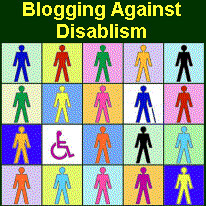
This post is a part of Blogging Against Disablism Day.

For most people, health is not life’s goal. Public health is not a religion, or, as recently seen in the United States of America, health is a journey, not a destination. Health is a means to an end, it is a resource for living the full life, not something to be pursued in an obsessive way that denies risk enjoyment and testing limits.

[John R Ashton and Lowell Levin, “Beware of Healthism”]

How many people with disabilities participated in Australia’s 2020 Summit?

According to the Australian Bureau of Statistics, 19% of the young (aged 5-64) population have disabilities, and numbers are much higher after retirement age. If people with disabilities (PWD) are considered full citizens and had proportional representation at the Summit, of 1000 working-age participants, you might expect nearly two hundred people with disabilities having their say at the Summit.

Of people with disclosed or visible disabilities, however, the current count seems to stand at less than ten. According to one source, there were six. The fact that these numbers are difficult to obtain shows how important this issue is in the able-bodied national psyche.

On this information, that’s PWD underrepresented by a factor of thirty. How many protests would there be if there had been only 16 women at the Summit? The country scrutinised gender inclusion closely and at length, both in the mainstream media and in the blogosphere. This disablist inequality puts that to shame.

You can download the Initial Report of the Australia 2020 Summit here.

The report opens with “The Productivity Agenda”. The focus on a competition economy labels us as marginal citizens, if we are not economically useful. We are primarily a problem for capitalism, a burden to be reluctantly dealt with. We are not seen as people with thoughts and ideas and lives, people who have their own perspectives and contributions to Australia’s civic society and cultural life.

Continue reading BADD: The radical notion that people with disabilities are people, and Australia’s 2020 Summit